
Do Wet Soil Regions Influence Following Summer Climate in the U.S.?
04/20/2026, 8:42 am EDT
Comparing (Climate Impact Co.) Constructed Analog and (ECMWF) Probabilistic Wind Climate Forecast for Australia
04/24/2026, 8:43 am EDT
Climate Impact Company Month 1-5 Ahead Forecast
India Summer 2026 Outlook
Issued: Wednesday, April 22, 2026
Highlight: Wet +IOD runs some interference on dry El Nino climate, at times, during the India Monsoon Season.
Executive Summary: The Climate Impact Company constructed analog climate forecast for summer 2026 across India is issued. The forecast is confidently based on an emerging strong El Nino, which has a drying effect on India and a less confident evolution of positive phase Indian Ocean dipole, normally a wet influence on India climate. The JUN/JUL/AUG 2026 precipitation forecast across India is mostly dry according to CIC although with some locally patchy wet month-to-month areas. The patchy wet areas are in response to +IOD. ECMWF indicates a failed wet monsoon likely too aggressive due to some wet influence of +IOD on the drier EL Nino climate regime.
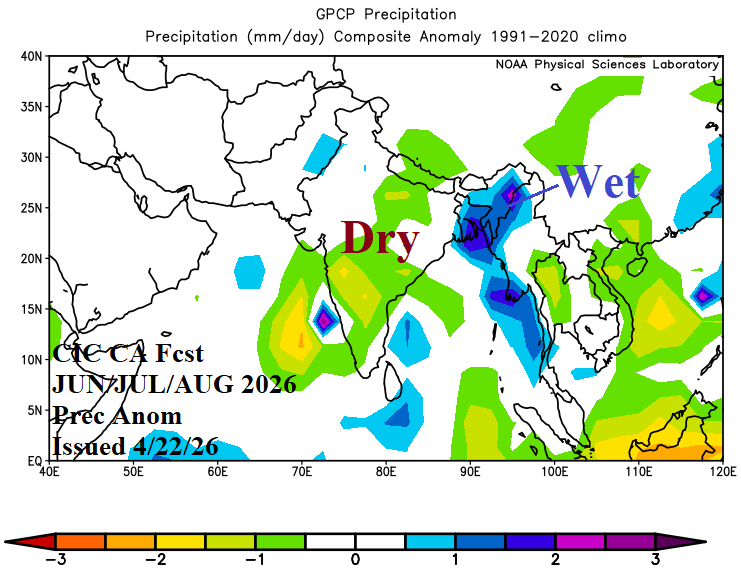
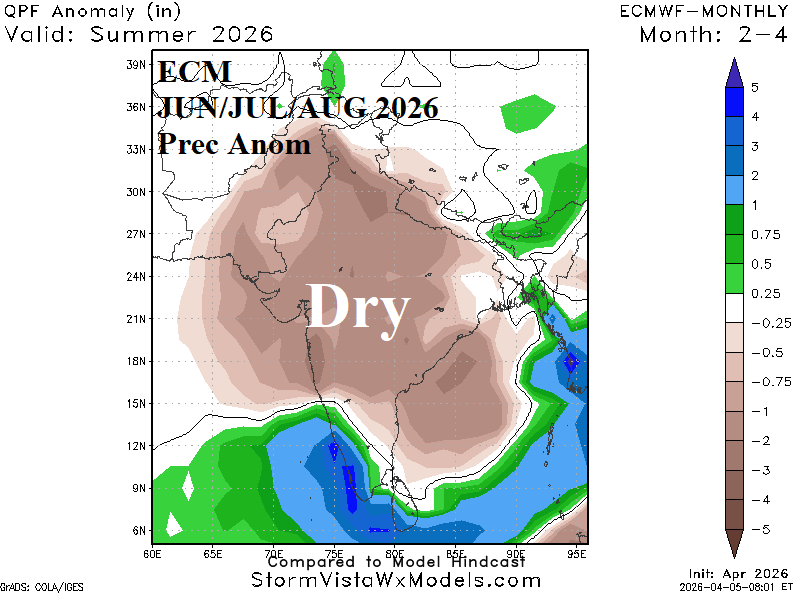
Fig. 1-2: The Climate Impact Company constructed analog JUN/JUL/AUG 2026 precipitation anomaly outlook compared with ECMWF.
Climate discussion: The India climate pattern for summer 2026 is regulated by anticipated evolution of strong warm El Nino southern oscillation (ENSO) and positive phase Indian Ocean dipole (+IOD). Forecast confidence in evolution and rapid intensification of El Nino is above average. Upper ocean heat in the equatorial East Pacific is near record strength (Fig. 3), and the attendant potential energy strongly supports a major El Nino episode ahead as forecast by most dynamic models (Fig. 4). The 2026 El Nino is expected to rival the intense El Nino episodes of 1982-83, 1997-98, 2015-16, and 2023-34. During each strong El Nino, +IOD formed although with varying strength and duration (Table 1). Forecast models (also) vary on strength of +IOD for the Indian Monsoon Season (JUN-SEP). Most IOD forecasts firmly project +IOD for the duration of the summer season while NCEP/CFS V2 and especially ABOM/POAMA are hesitant to indicate +IOD. Climate Impact Company expects El Nino by MAY and strong El Nino by JUL/AUG with strong +IOD lagging by one month. The India summer forecast ius based on the strong El Nino/+IOD evolution.
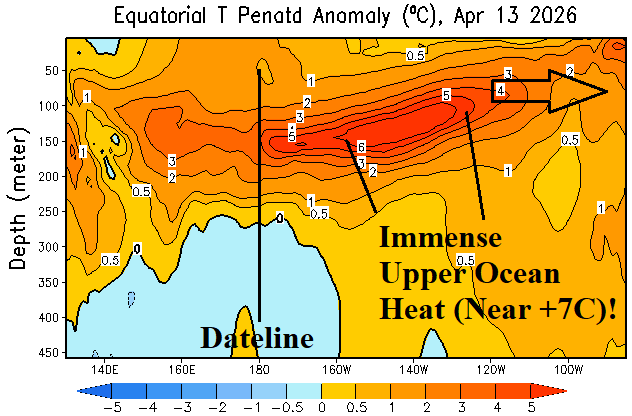
Fig. 3: The near record strength subsurface warming of the equatorial East Pacific represents immense upper ocean heat to fuel a potent El Nino ahead.
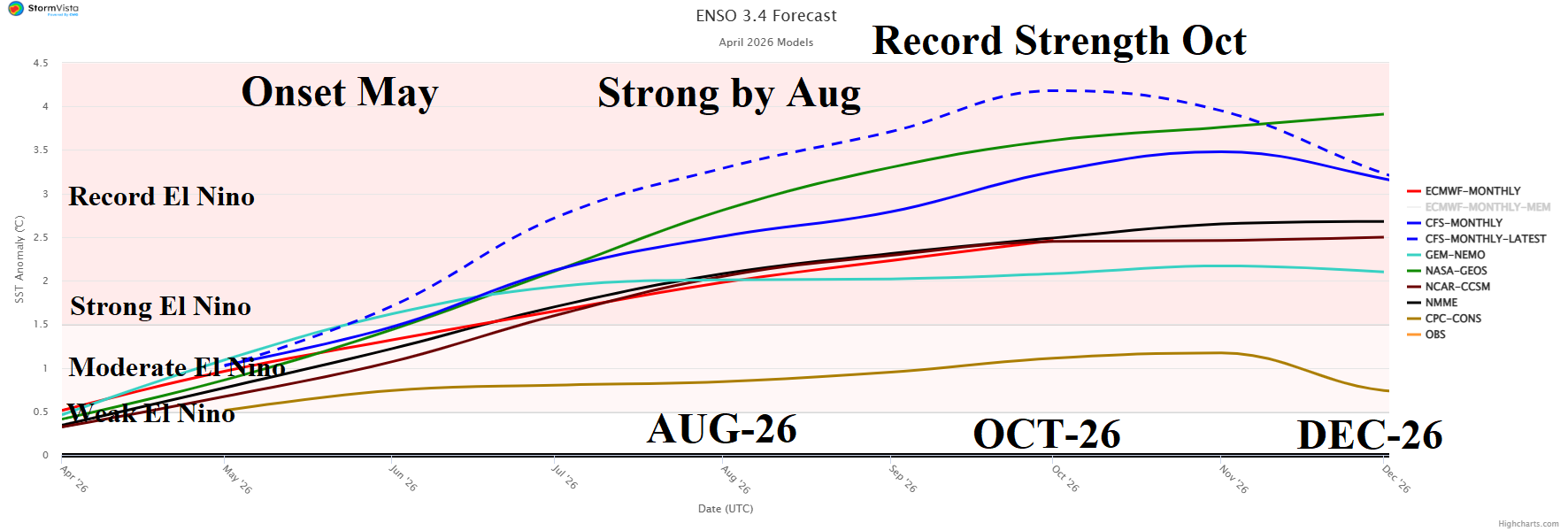
Fig. 4: Various dynamic models and their Nino34 SSTA forecasts for 2026. Several models are forecasting the strongest El Nino on record.
| MAY/JUN/JUL | AUG/SEP/OCT | |
| IMME/NMME | +IOD | +IOD |
| ECMWF | +IOD | +IOD |
| ABOM/POAMA | Weak +IOD | Neutral IOD |
| CFS V2 | Neutral | Weak +IOD |
| UK MET | +IOD | +IOD |
Table 1: Various dynamic models and their IOD phase projections for MAY/JUN/JUL and AUG/SEP/OCT 2026.
May 2026: ECMWF “weeklies” favor a wet May across India. Consequently, the near normal precipitation climate forecast by ECMWF “monthlies” is favored over the CIC-CA forecast which is very dry in Northeast India.
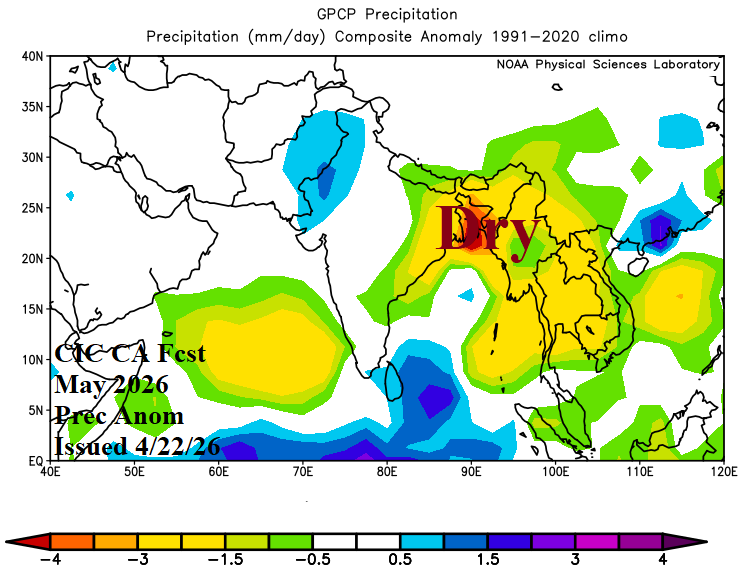
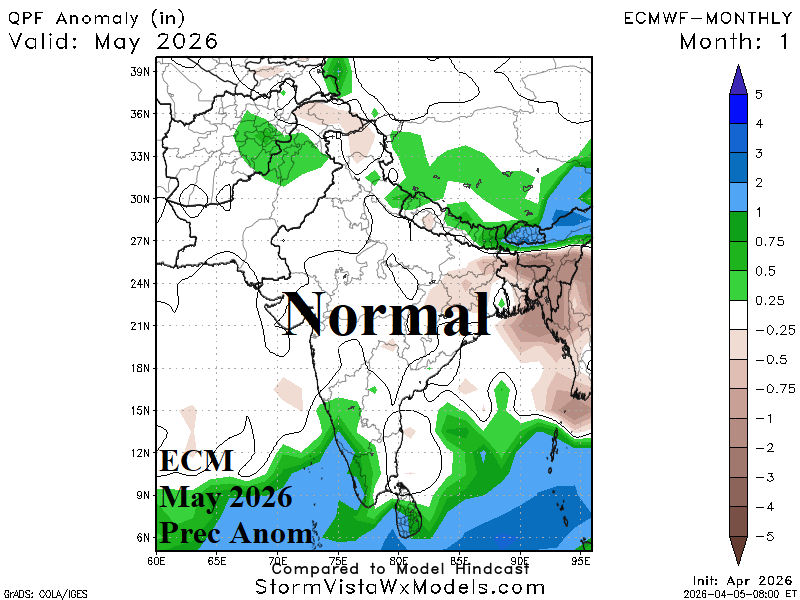
Fig. 5-6: The Climate Impact Company constructed analog MAY 2026 precipitation anomaly outlook compared with ECMWF.
June 2026: As El Nino develops a drier climate emerges across India. ECMWF is too dry. CIC-CA also indicates wet opportunities in far southwest and northeast India during June while dryness is developing in Central India, mostly in response to El Nino.
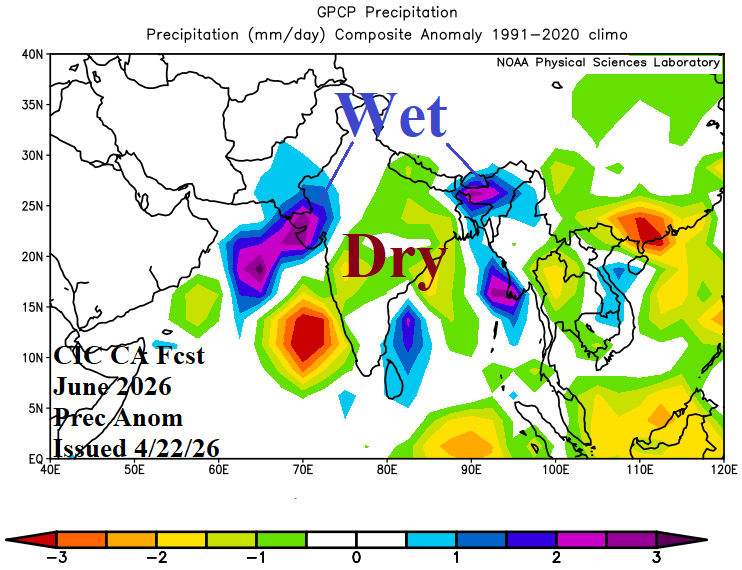
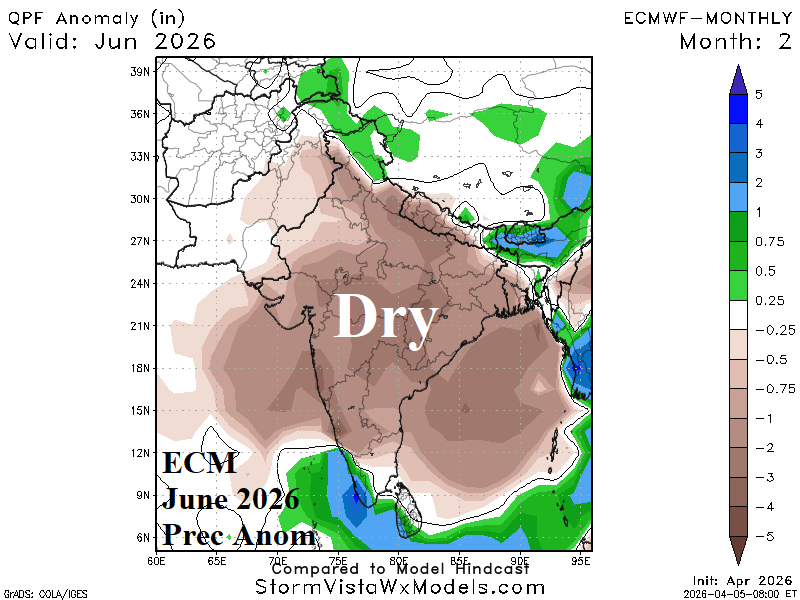
Fig. 7-8: The Climate Impact Company constructed analog JUN 2026 precipitation anomaly outlook compared with ECMWF.
July 2026: +IOD develops mid-summer, usually a wet signal for India. Meanwhile El Nino is intensifying, a strong dry signal for India. The (dry) El Nino signal is confidently forecast therefore the dry CIC-CA outlook is reasonable; ECMWF is too dry.
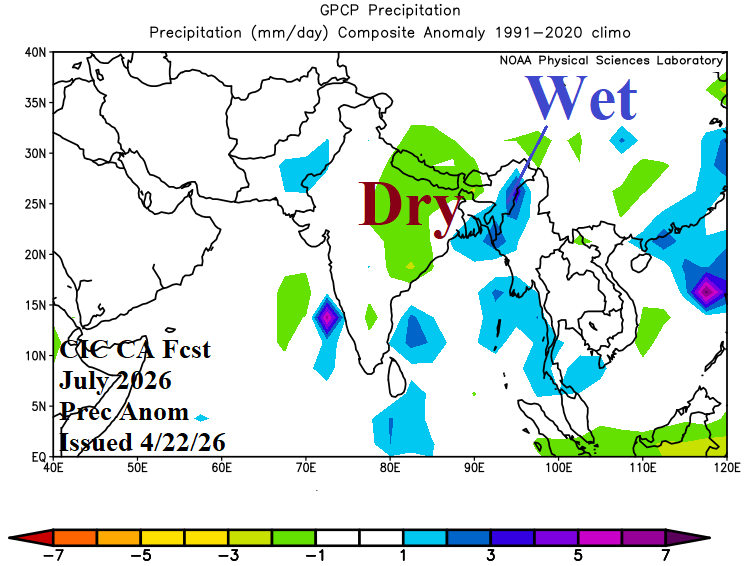
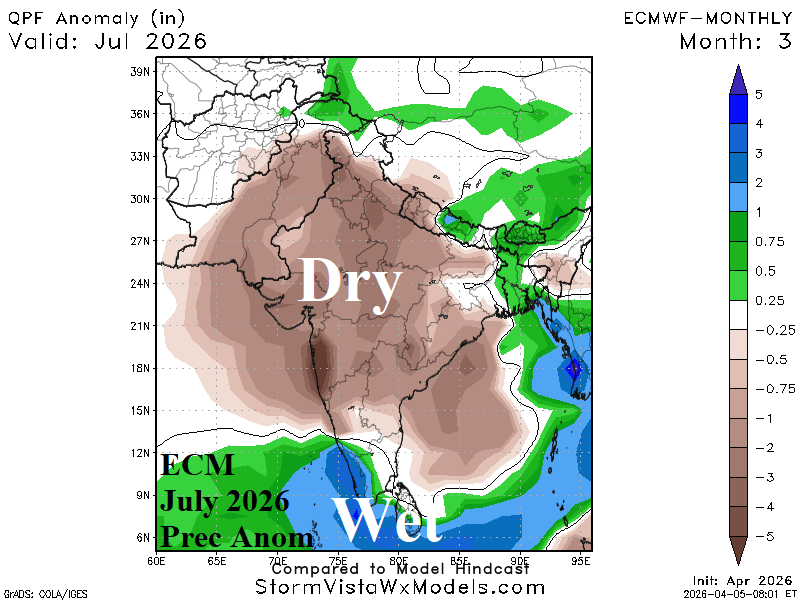
Fig. 9-10: The Climate Impact Company constructed analog JUL 2026 precipitation anomaly outlook compared with ECMWF.
August 2026: Mixed wet (+IOD) and dry (El Nino) signals in August causes the CIC-CA forecast to project both dry and wet extremes, driest across south India. ECM features mixed dry/wet signals.
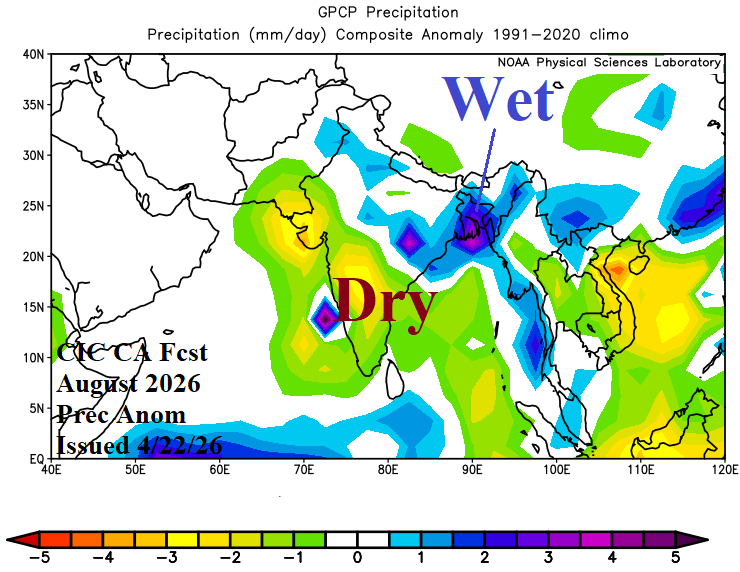
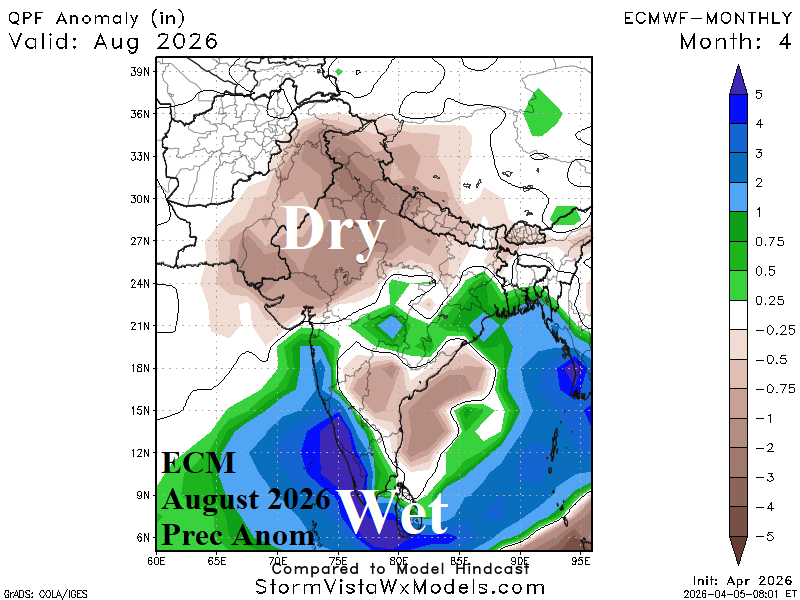
Fig. 11-12: The Climate Impact Company constructed analog AUG 2026 precipitation anomaly outlook compared with ECMWF.
September 2026: In September, mixed wet (+IOD) and (dry) El Nino signals continue to mix causing normally wet weather in South/East India and dry elsewhere according to CIC-CA while ECMWF is aggressive dry.
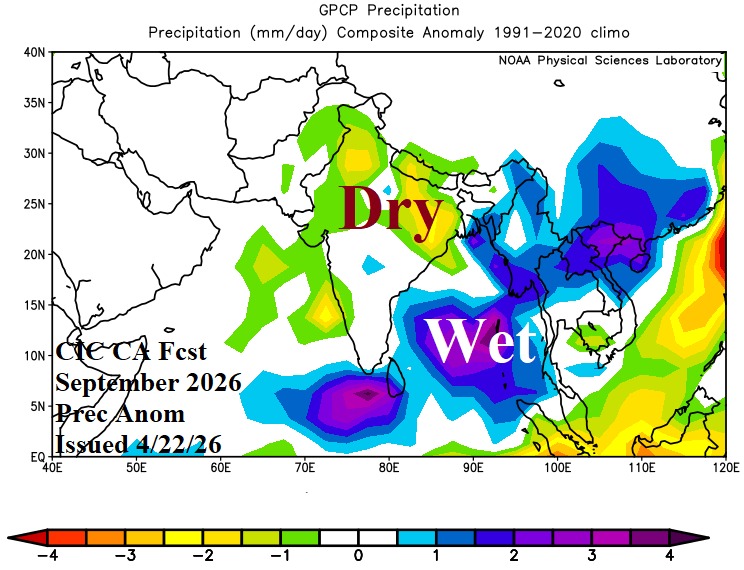
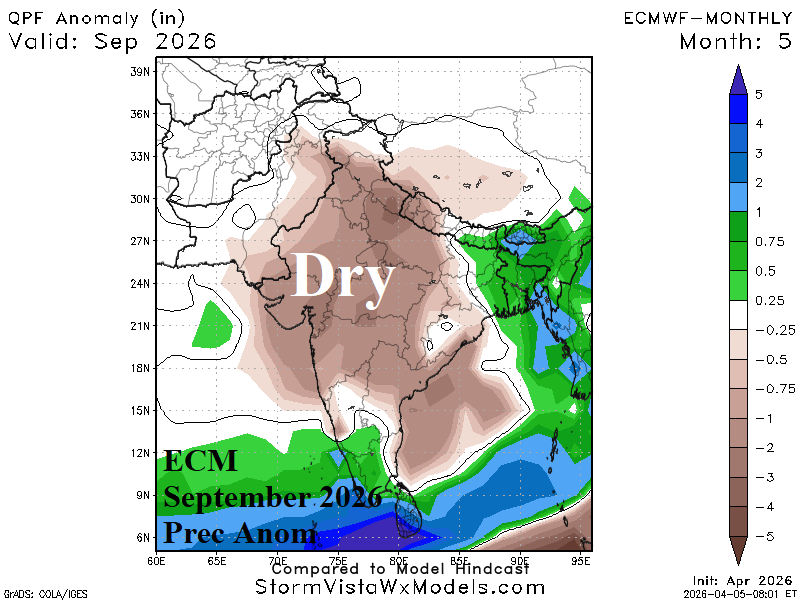
Fig. 13-14: The Climate Impact Company constructed analog SEP 2026 precipitation anomaly outlook compared with ECMWF.