04/29/2024, 5:08 am EDT

ECM ENS (Dynamic Model) Vs. AI 4CastNet V2 (AI Model) for U.S. in 10+ Days

Siding with the AI 4Cast Net V2 forecast direction heading into mid-May. Why? Cooling of the western North Atlantic as previously stated last week. NCEP CFS V2 is the operational model capturing this philosophy. The model is substantially cooler than ECM. A marked cool change is indicated for the Midwest U.S. with a southern shift from Canada to the Mid-south States of the wet weather belt. A major change!
04/28/2024, 11:59 am EDT

New Transitional U.S. Thermal Pattern Lowers Forecast Skill

Dynamic meteorological models generally have increased error during the cold-to-warm transition season. The 30-day skill scores of leading models are generally consistent with long-term averages for this time of year. However, the short-term (7-day) forecast skill has recently lowered.
04/26/2024, 4:35 am EDT

Cooling Western North Atlantic Foreshadows Cooler East U.S. Coast Weather in May

A super warm global ocean surface is in the news! However, not all oceanic zones are warm. Norte the 1-year change in the western North Atlantic. The western North Atlantic has cooled to near normal during mid-spring. The cooling waters foreshadow presence of an upper trough on the East Coast for much of May.
04/26/2024, 3:44 am EDT

Kansas Drought Worsening; Incoming Rains Miss Southwestern Kansas

Yesterday’s NOAA/USDA drought analysis across Kansas reveals worsening conditions. Although harsh extreme to exceptional drought is not present, almost all of Kansas (97.9%) is abnormally dry to severe drought. Drought worsening is most apparent in the 3-month change which reveals an increase of 38% to 65% of D1 drought conditions and 5.5% to 17% of D2 (severe drought) conditions.
04/23/2024, 7:58 am EDT

Prohibitive Wet Weather Ahead for Central U.S.

Persistent cool phase Pacific decadal oscillation causes return visits of an upper trough into the West U.S. and that pattern redevelops to close April. A moist southerly flow develops over the Great Plains ahead of the trough and causes heavy to excessive rain in the Great Plains heading into early Maine.
04/23/2024, 3:58 am EDT

The Influence of Marine Heatwaves on Record Warm Global SST

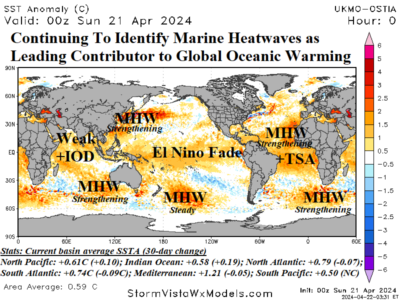
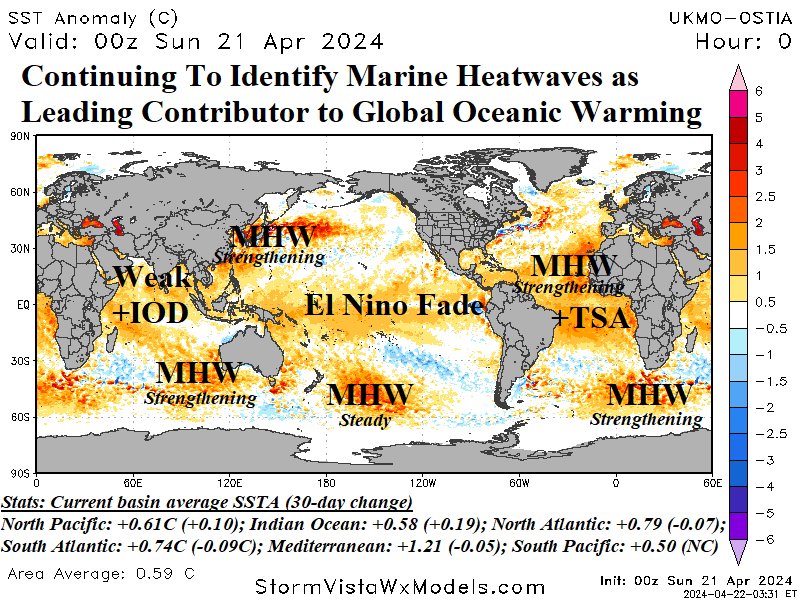
March 2024 brought the 12th consecutive month of record warm global oceans. The daily global SSTA analysis reveals the influence on record warm global oceans by marine heatwaves (MHW). Several MHW’s are steady or strengthening in the southern hemisphere while the second year of a MHW off the Northwest Africa Coast is regaining strength and a new MHW is forming off the coast of East Asia.
04/22/2024, 1:41 pm EDT

New Marine Heat Wave Off East Asia Coast

A large marine heat wave (MHW) is developing off the East Asia coastline and is strengthening. Consequently, CFS V2 is forecasting a large high-pressure area to develop across the MHW during the summer season.
04/22/2024, 1:37 pm EDT

12Z GFS Cold Bias Polar Region; Warm Bias Near U.S./Canada Border Past 30 Days

The midday 12Z GFS temperature bias for the 6-10-day period during the past 30 days is marginally warm in Southern Canada and the North-central U.S. but overall reasonable skill. In the 11-15-day period, the polar region is much too cool while forecast bias near the U.S./Canada border has averaged too warm.
04/18/2024, 11:52 am EDT

Latest NOAA/CPC Long-lead Climate Outlooks; Hot Risk Most of U.S. Summertime

Meteorological summer (JUN/JUL/AUG) 2024 remains forecast warmer than normal for all but North Dakota with highest hot weather probability likely from the Interior Northwest to Western Texas and in New England. The precipitation outlook is biased wet in the East and Southeast U.S. while West-central States including the western Great Plains are drier than normal.
04/17/2024, 2:59 pm EDT

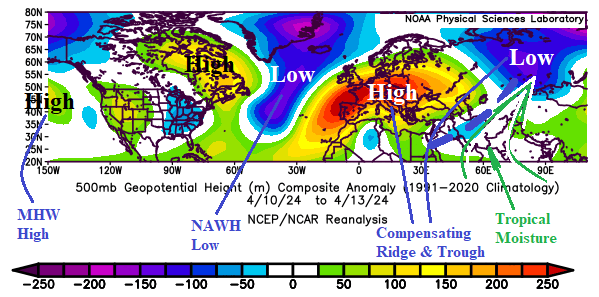
MJO, NAWH, and IOD Contribute to Southern Ural Region/Northern Kazakhstan to Dubai Flooding

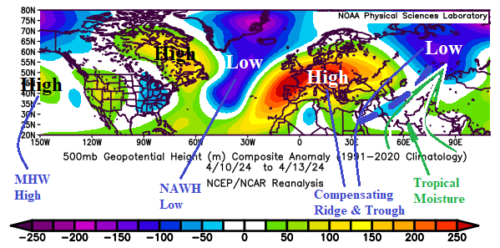
Extreme weather events or climate regimes are often blamed on climate change (or global warming). However, rarely are the weather/climate synoptics causing the event identified and reviewed. An attempt to identify the catalyst to recent historic flooding in the Southern Ural region of Russia to Northern Kazakhstan and adding Dubia well to the south is provided.
04/16/2024, 4:39 am EDT

El Nino Fades; Speed of Development/Intensity of La Nina Ahead Uncertain

The Nino34 SSTA region has cooled a whopping 0.69C during the past 2 weeks as El Nino 2023-24 is about to end. The record warm global ocean surface of the past 12 months is unique and causes uncertainty regarding the speed of development and intensity of La Nina for later in 2024.