
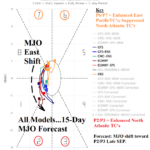
MJO East Shift: Support for North Atlantic Basin Tropical Cyclones Increasing Later September
09/17/2026, 5:09 am EDT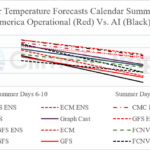
During Calendar Summer 2026. Operational Models Edge AI in Skill
09/22/2026, 4:52 pm EDT
Climate Impact Company IOD Outlook
Issued: Monday, September 21, 2026
Headline: Strong positive phase is emerging, likely to carry into early 2027.
Discussion: The daily Indian Ocean Dipole (IOD) index is +1.01C indicating presence of strong positive phase which initiated several weeks ago although the Dipole Mode Index (DMI) was +0.68C for AUG-26 suggesting +IOD may have formed during later July. Australia Bureau of Meteorology indicates +IOD will continue through Q4/2026 with an average index of +0.8C rivaling 2023 (+09C), 2019 (+0.9C), 2018 (+0.6C), and 1997 (+1.2C). Only 2023 and 1997 +IOD regimes were concurrent with El Nino episodes. Both the +IOD and El Nino were stronger in 1997 compared to 2023. However, marine heatwaves (MHW) off the West and Southeast Coast of Australia, similar with 2026, were observed during late 2023 and not 1997. Reasonable is an equally weighted analog between the stronger +IOD/El Nino of late 1997 and the less strong but MHW inclusive 2023 +IOD/El Nino episode.
Using the 1997-98 and 2023-24 +IOD/El Nino episodes to produce an analog forecast through mid-2027 yields a strong positive phase lasting through Q4/2026 and into early 2027 before fading to neutral phase next March (Fig. 1). Utilizing all analog years (since 1950) and weighing each equally produces a less intense +IOD for Q4/2026 and quicker dissipation early next year (Fig. 2). A third IOD analog which gives increasing weight to the most recent +IOD years (due to climate change [acceleration of warming oceans]) referred to as a “modern” analog, indicates a slightly stronger IOD than the standard IOD index forecast (Fig. 3).
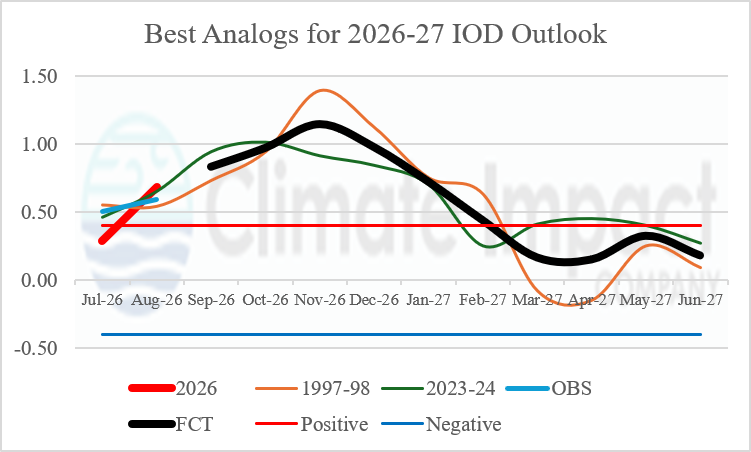
Fig. 1: The most recent +IOD/El Nino analog years comparable to 2026 yield strong +IOD lasting into early 2027 before fading to neutral phase MAR-JUN 2027.
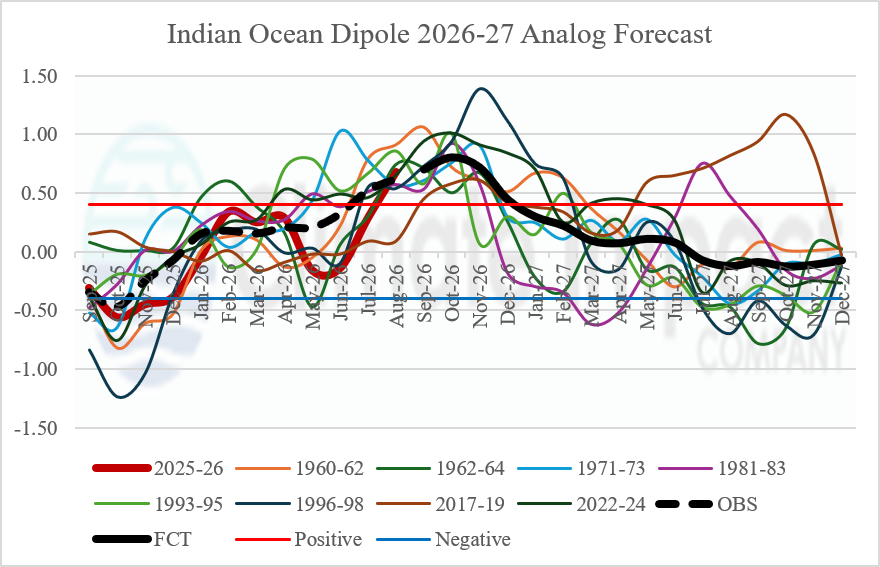
Fig. 2: ALL IOD analog years, equally weighted, to project the 2026-27 IOD forecast.
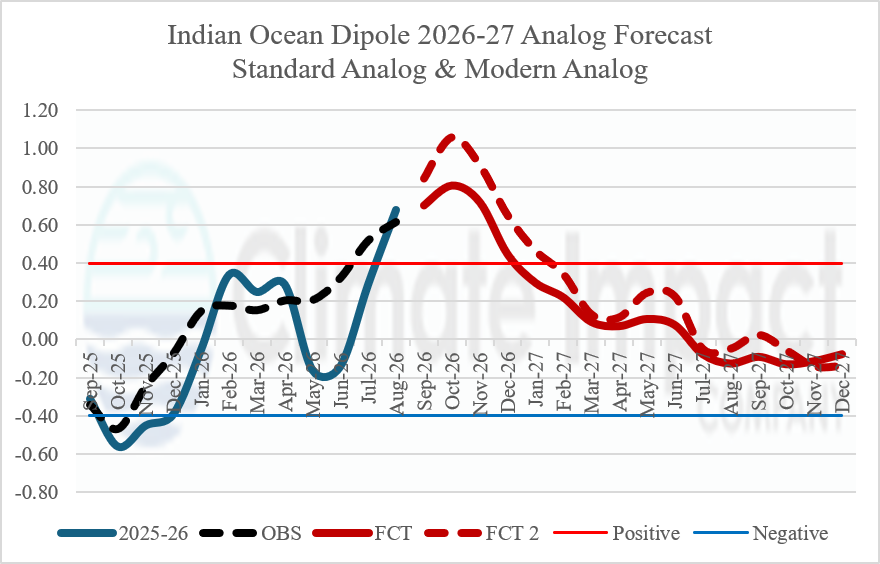
Fig. 3: ALL IOD analog years, equally weighted, compared to the “modern” IOD index which weighs recent decades (more) heavily to project the 2026-27 IOD forecast.