
Record warm Nino34, Nino3, and Nino12 SSTA Still Warming
09/29/2026, 8:40 am EDT
Super El Nino Continues to Intensify!
10/05/2026, 2:06 pm EDT
Climate Impact Company Marine Heatwave Research No. 1
Issued: Friday October 2, 2026
Highlight: Large marine heatwaves (and cool pools) and their influence on regional climate.
Discussion: A lot of inquiries during recent days on influence of marine heatwaves and their influence on regional climate. The big topic right now is Super El Nino. But! Increasingly, large areas of oceanic warming (and cooling) are having significant influences on regional climate. Let’s review where these warm (and cool) pools of ocean water are located and their regional influence on climate.
First up, is not a marine heatwave, but rather a semi-permanent cool pool of water located south of Greenland known as the North Atlantic warm hole (NAWH). Initially, climate scientists blamed the evolution of the NAWH (beginning 2013-14) on accelerated Greenland ice and snowmelt during spring due to increased high latitude warming. The runoff created a stratified pool of ocean water south of Greenland cooler than the surrounding warming North Atlantic with lower salinity. Initially, this phenomenon was cited as a contributor to the slowdown of the Atlantic meridional over-turning current (AMOC). The NAWH is not new. New is the semi-permanent character of this feature during the past 12-13 years.
The cool pool of water has a consistent correlation in the upper air pattern (Fig. 1-2) as an upper-level low-pressure trough is semi-permanent across or downwind the NAWH with compensating upper-level high-pressure ridge over Europe contributing to increased risk of mild Europe winter and summertime anomalous heat and drought. The semi-permanent high pressure over Europe is a contributor to MHW’s in the Mediterranean Sea and West and North Coast of Europe (as observed in 2026).
Second, is the Kuroshio Marine Heatwave. Climate research reveals the Kuroshio Current is widening, warming, and pushing northward first recognized in 2018. The daily SSTA analysis reveals the current intensity east of Japan (Fig. 3). The Kuroshio Extension often reaches the Northeast Pacific. During 2018-25 Kuroshio warming and expansion, 500 MB anomaly analysis reveals a semi-permanent high pressure across the Northern Pacific Ocean (Fig. 4) influencing East Asia and North America climate, generally warmer.
This new phenomenon has completely changed the character of cool phase Pacific decadal oscillation (-PDO). The warming and expanding northward shifting Kuroshio Current leaves the Northwest Pacific often record warm while the Northeast Pacific is generally warmer than normal (in this decade) but not as (anomalous) warm as the Northwest Pacific. The SSTA comparison between each corner of the North Pacific yields -PDO, present this entire decade often at record strength. However, the -PDO of this decade is dissimilar with the conventional -PDO observed in years past (Fig. 5-6).
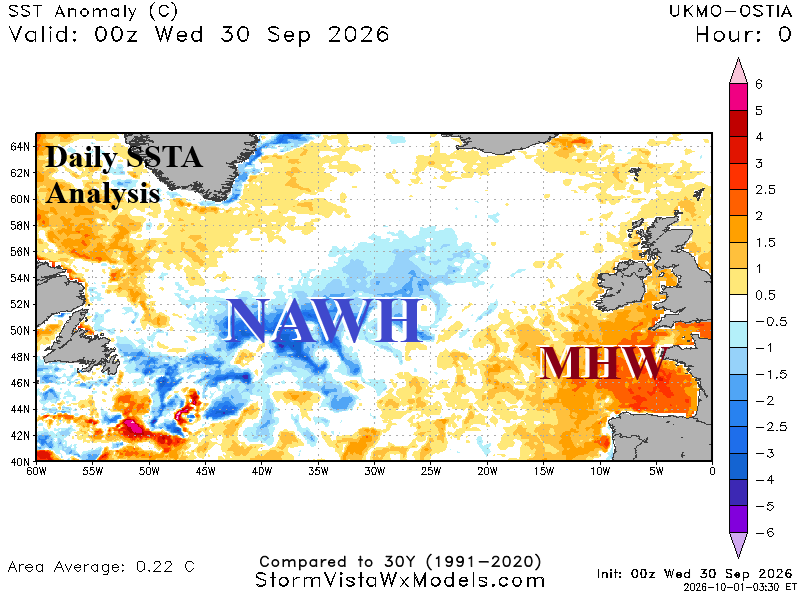
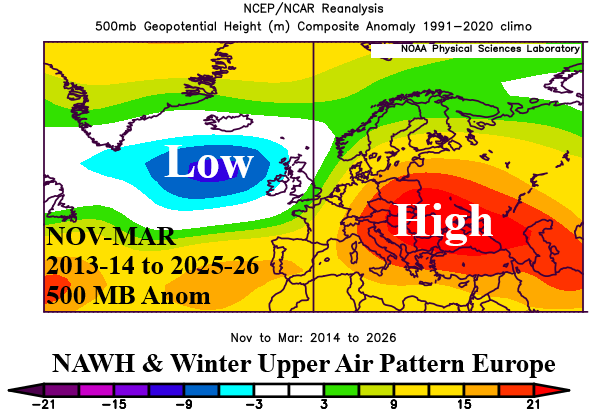
Fig. 1-2: Daily SSTA analysis identifies the NAWH pattern. During the cold season of the past 12-13 years, as NAWH became dominant, a strong and persistent correlation to the upper air pattern developed heavily influencing Europe climate.
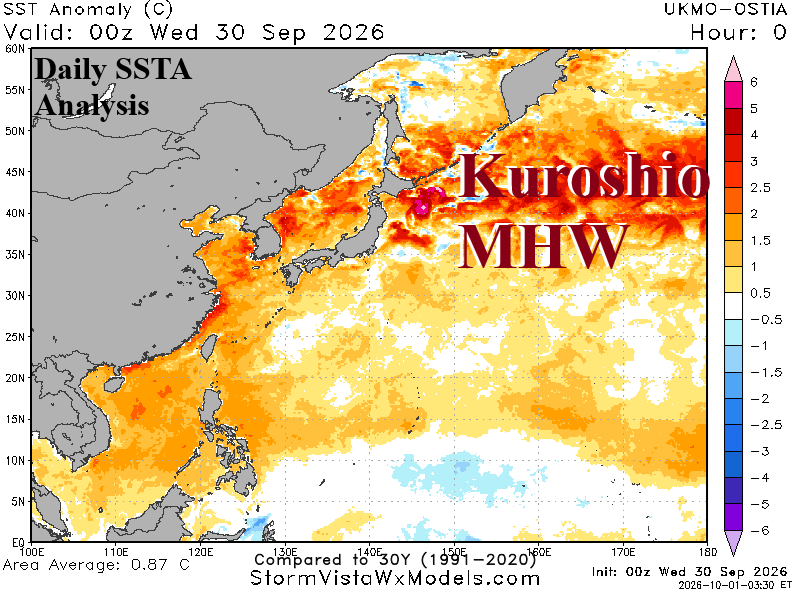
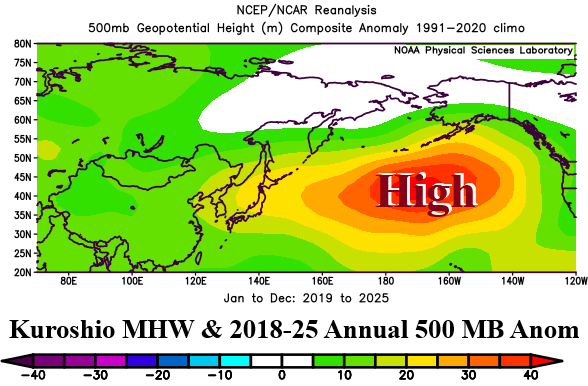
Fig. 3-4: Daily SSTA analysis identifies the current extremely warm MHW associated with the Kuroshio Current and (since 2018) the prevailing 500 MB anomalies analysis across the North Pacific.
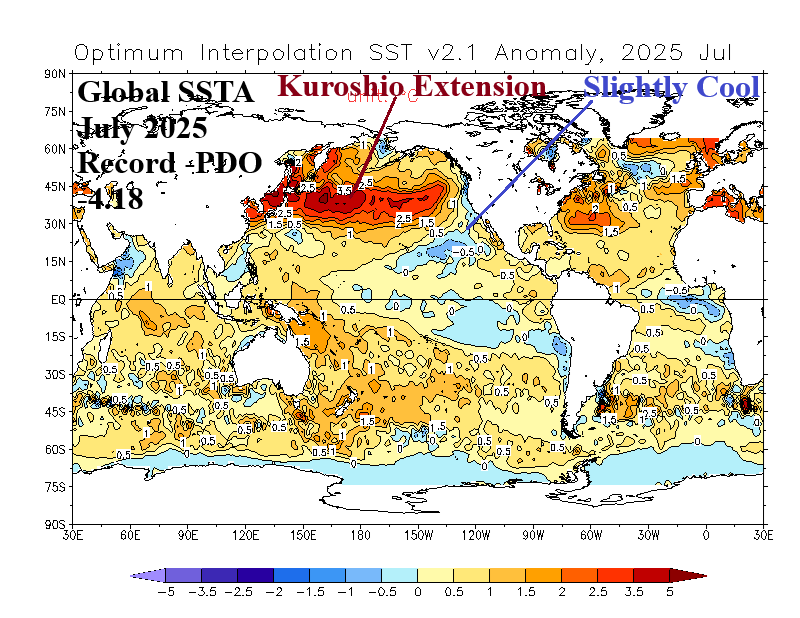
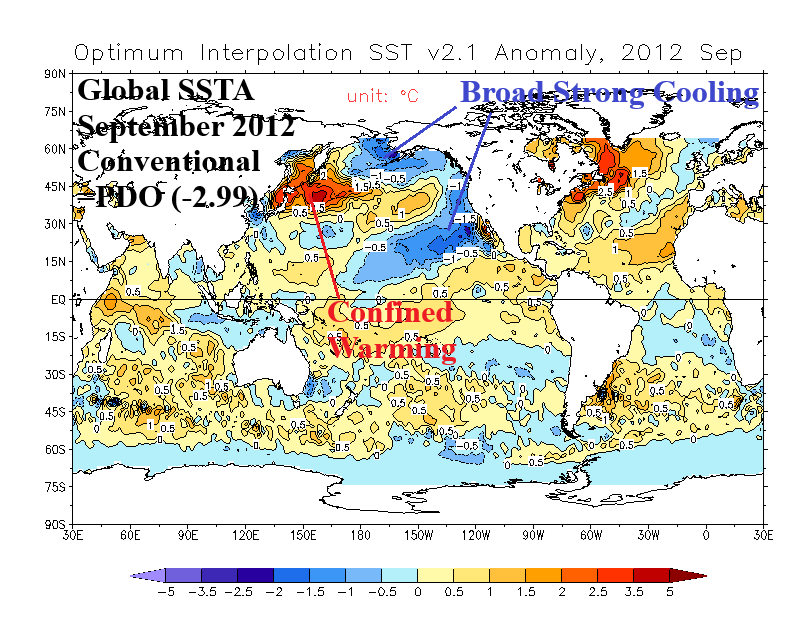
Fig. 5-6: Global SSTA analysis for July 2025 and September 2012. Each month produced strong cool phase of the Pacific decadal oscillation. Notice the modern-day -PDO features very warm Northwest/North Pacific SSTA versus less warm Northeast Pacific SSTA associated with the Kuroshio MHW. Conventional -PDO was associated with widespread cooling of the Northeast Pacific.