
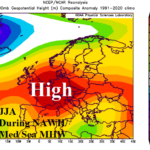
NAWH/Mediterranean Sea MHW Influence Supports Hit/Dry Europe Summer High-pressure Ridge
04/22/2026, 2:21 pm EDT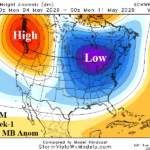
Major Snowmelt Warm-up in Southwest Canada Ahead!
04/28/2026, 4:45 pm EDT
April 2026 Climate Impact Company Marine Heat Waves Outlook
Issued: Thursday April 23, 2026
Global marine heatwave aerial coverage is 27% and forecast to reach 40%, possibly 45%, by late Q3/2026. With El Nino, a record warm global ocean is expected later this year.
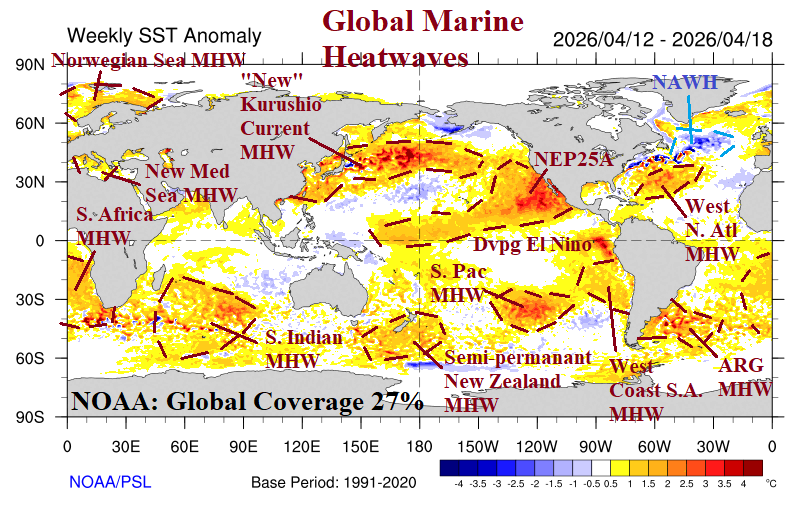
Fig. 1: Global sea surface temperature anomaly (SSTA) analysis and identification of various marine heatwaves.
Discussion: According to NOAA, aerial coverage of global marine heatwaves (MHW) is 27% (Fig. 1). The forecast for aerial coverage from early this year, valid for March, was 23%. Consequently, MHW presence is over-achieving. NOAA is forecasting MHW aerial coverage to increase to 40% later this year, in part due to El Nino. Given the over-achieving presence of MHW as Q2/2026 arrives, Climate Impact Company estimates aerial coverage possibly as high as 45% by AUG/SEP/OCT and likelihood of the warmest ocean surface on record. The most prominent MHW is NEP25A off the West Coast of North America which extends nearly 5,000 miles to west of the Dateline in the Pacific tropics. NEP25A is linked to record warm temperatures across the West and Central U.S. during Q1/2026. NEP25A will continue to intensify. The “New” (since 2018) Kuroshio Current (KC MHW) is strengthening and rapidly reaching eastward across the North Pacific. Coupled with an intense El Nino after mid-year, NEP25A and the KC MHW should cause a record warm North Pacific by later Q3/2026. A new MHW is likely to intensify in the Mediterranean Sea and is ongoing in the Norwegian Sea. The semi-permanent North Atlantic Warm Hole (NAWH) south of Greenland is strengthening. During the past 10 years, presence of the NAWH and strong Mediterranean Sea MHW have contributed to a strong summertime high pressure ridge over Europe on 7 occasions. The West North Atlantic MHW will expand westward and strengthen and include the Gulf of Mexico during summer 2026. In the southern hemisphere, 5 large MHW’s are observed. The Argentina Coast, South Indian Ocean, and New Zealand MHW’s are strengthening while MHW’s off the West Coast of South America have weakened slightly, and intensity is steady in the South Pacific and off the Southwest Coast of Africa.