
El Nino Onset Ignites U.S. Pattern Change
05/13/2026, 12:25 pm EDT
Focus on U.S. Soil Moisture/Rainfall Forecasts and ENSO Update
05/17/2026, 10:07 am EDT
Climate Impact Company Daily Feature
Issued: Thursday, May 14, 2026
Highlight: The Springtime ENSO Prediction Barrier LINGERS!
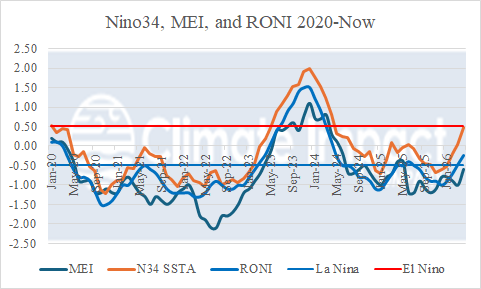
Fig. 1: A comparison of Nino34 SSTA, multivariate ENSO index, and relative operational Nino index for this decade.
Discussion: According to ECMWF, ENSO forecast uncertainty is largest during MAR-MAY (ENSO springtime prediction barrier), improving substantially by JUN. Key diagnostics to justify an El Nino forecast late in the prediction barrier timeframe are weakening or reversing trade winds in the equatorial East Pacific and warming of the central equatorial Pacific Ocean.
Currently, the central equatorial Pacific Ocean has warmed significantly reaching +1.17C as of May 13. The relative Nino4 SSTA is not as anomalous but certainly within the El Nino threshold. Wind direction in the equatorial East Pacific continued to have an east-to-west average component although cross equatorial in character representative of positive phase Pacific meridional mode (+PMM) which is supportive of El Nino development.
ECMWF states that the buoyant Nino34 SSTA forecasts for 2026 are (largely) driven by the robust warming of the subsurface equatorial Pacific Ocean which was not present during APR-17 ahead of an infamous El Nino forecast failure.
Another helpful diagnostic to support the strong El Nino forecasts is sustained negative phase southern oscillation index (-SOI). Today’s SOI is very negative according to The Queensland Long Paddock observations. However, the 30-day SOI is barely past the El Nino threshold (-0.57) and remains choppy negative in character. CWG/SVWM 15-day SOI forecasts indicate the choppy negative character continues.
The Madden Julian oscillation (MJO) shifts eastward toward the Dateline over the next 2+ weeks with marginal intensity. A stronger MJO shifting east of the Dateline is preferable to produce sustained -SOI and weakens equatorial trade winds and this possibility awaits late May/early June at the earliest.
In summary, we are experiencing elements of the ENSO springtime predictability barrier, specifically, lack of a sustained atmosphere-to-ocean link to force an El Nino climate. The equatorial oceanic warming is there but the atmospheric reflection lags.
Additional factors leading to uncertainty of ENSO forecasts is the addition of the much warmer ocean surface poleward of the tropics. Climate Impact Company has observed frequent examples of Nino34 SSTA, used to identify oceanic ENSO phase, not well-correlated with multi-variate ENSO index (MEI) which is used to identify the atmospheric reaction to tropical ocean SSTA/SLPA regimes (Fig. 1). In this decade, MEI is La Nina-biased and not willing to match Nino34 warming during El Nino. Notice that the relative operational Nino index (RONI) has similarity to MEI which justifies NOAA and Australia Bureau of Meteorology implementation of this new (ENSO) diagnostic. Certainly, as of MAH-26, MEI and RONI strongly lag Nino34 SSTA.