
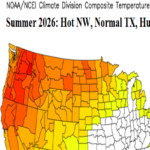
Latest Summer Outlook for U.S. Implicates Northwest with Possible Record Heat/Drought Expansion
04/21/2026, 5:43 am EDT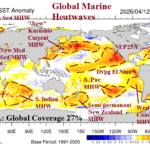
Global Marine Heatwave Aerial Coverage is 27% and Forecast to Reach 40% Q3/2026
04/23/2026, 8:28 am EDT
Climate Impact Company AG Hot Spot
Issued: Wednesday April 22, 2026
Highlight: NAWH/Mediterranean Sea MHW and influence on summer upper air pattern for Europe…Hot and dry!
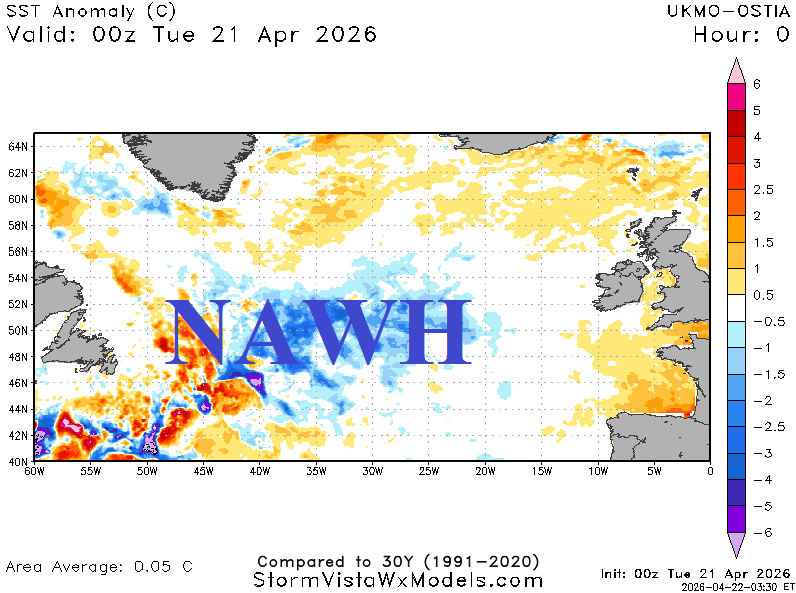
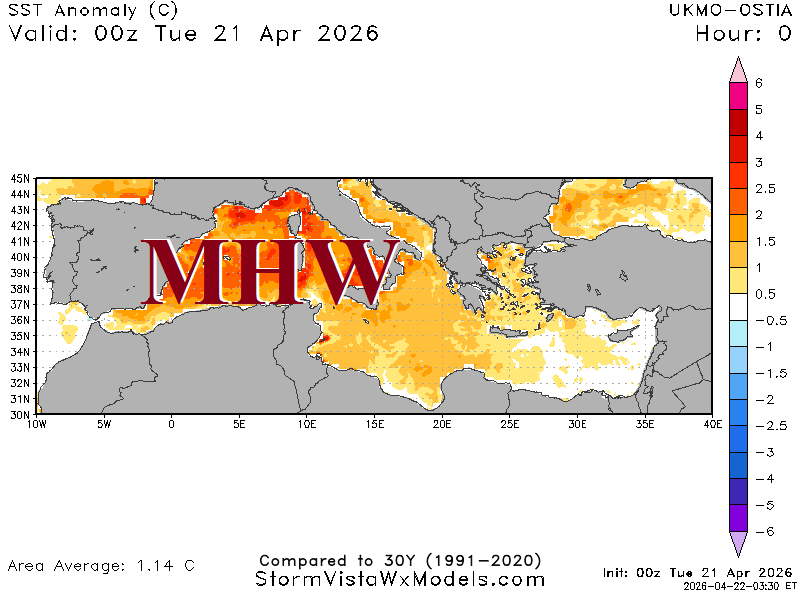
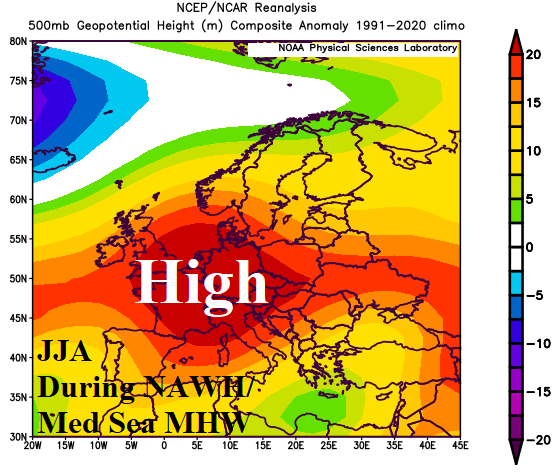
Fig. 1-3: The North Atlantic warm hole, Mediterranean Sea marine heatwave, and likely upper air pattern for summer 2026 if the SSTA patterns hold.
Discussion: Majority of the past 10 years of warm seasons have produced a cool pool of sea surface temperature anomalies (SSTA) south of Greenland while the Mediterranean Sea SSTA were exceptionally warm. The semi-permanent cool pool south of Greenland commonly referred to as the North Atlantic Warm Hole (NAWH) is part of the slowdown of the Atlantic Meridional Ocean Conveyor Belt (AMOC) which has slowed the transport of warm water in the deep tropics poleward. The anomalous warmth in the Mediterranean Sea is characteristic of the increasing tendency for marine heatwaves (MHW). Interestingly, 2 recent years (2023, 2024) when the regime described failed to develop, the North Atlantic basin set SSTA records. When the NAWH and Mediterranean Sea MHW were present during 7 of the past 10 meteorological summer seasons, the influence of the oceanic regime on the prevailing weather pattern across Europe is an amplified high-pressure ridge centered on France and Germany. The upper ridge caused a summer weather pattern featuring widespread anomalous heat and dryness affecting Europe and West/Southwest Russia to the Black Sea region. Above average risk of the described pattern developing during summer 2026 and affecting Europe/Western Russia is warranted.