

Atmospheric River Pattern to Emerge on West Coast
11/03/2026, 6:30 am EST
Climate Impact Company Gas/Power Report
Issued: Wednesday November 4, 2026
Highlight: JUN/JUL/AUG 2026 ranked middle of the road for CDD observed this century; DEC/JAN/FEB 2026-27 HDD forecast ranks 7th warmest this century. Mild Europe winter ahead.
Discussion: The 2026 cooling season (APR-OCT) across the U.S. indicated anomalous warmth developed in July and accelerated through September remaining very warm in October (Fig. 1). The warm acceleration mid-to-late summer was due to the influence of between 75 and 80 percent of the U.S. observing drought and the attendant dry soil moisture influence on prevailing climate during the warm season. The warming acceleration is evident with MAY-JUL 2026 near the 10-year normal warming to above the 10-year normal AUG-SEP 2026 (Fig. 2). Overall, the JUN/JUL/AUG 2026 meteorological summer CDD totals ranked 12th hottest and close to the 10-year normal in the 27-year 2000-26 climatology (Fig. 3).
The Super El Nino winter 2026-27 is forecast much warmer than normal. The U.S. gas population weight HDD forecast for NOV-26 through MAR-27 reveals somewhat warmer monthly HDD compared to the 10-year/30-year climatology (Fig. 4). There is risk of a warmer than indicated scenario while risk of a colder than expected forecast is low. The early HDD forecasts for DEC/JAN/FEB 2026-27 rank 7th warmest in this century (Fig. 5). The last Super El Nino observed winter 2015-16 produced a DEC/JAN/FEB gas population weight HDD total of 2288 compared to the 2366 HDD projection for meteorological winter 2026-27.
In Europe, the selected cities consensus cold season HDD forecast (Fig. 6) reveals a warmer than 10-year normal November for both regions followed by near the 10-year normal for Western Europe and warmer than the 10-year normal for Eastern Europe. Mid-winter is just beneath the 10-year normal. In February, both West and East Europe are projected to be much warmer than the 10-year normal while March is closer to the 10-year normal. Caveats? Eastern Europe could be colder than indicated.
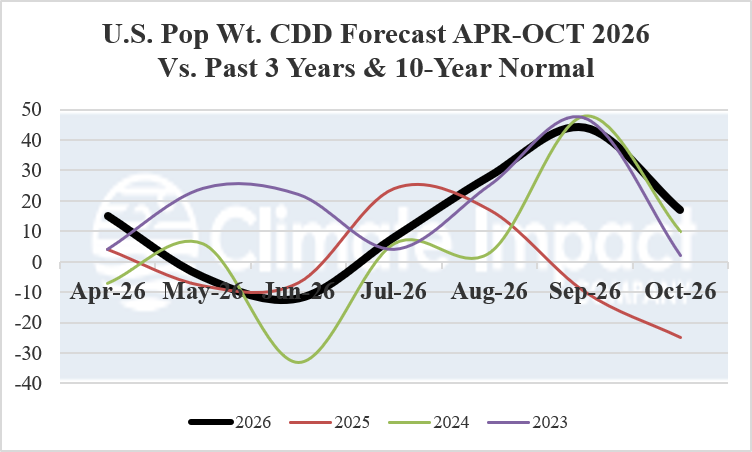
Fig. 1: The U.S. population weight CDD anomaly observation for each month of the 2026 warm season.
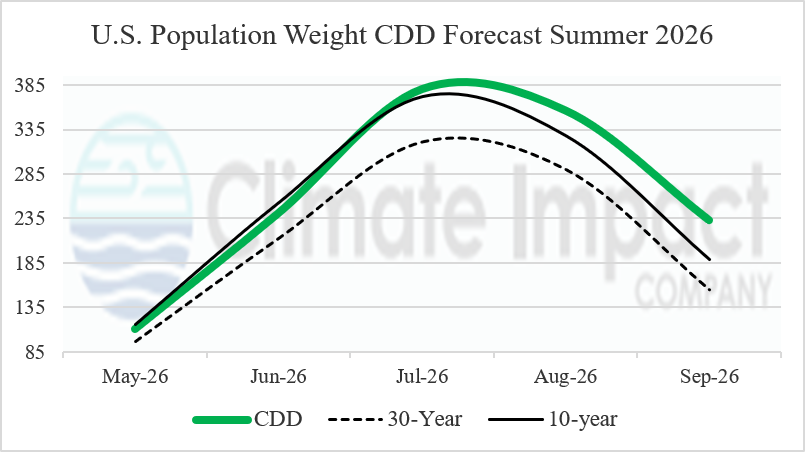
Fig. 2: The U.S. population weight CDD for MAY-SEP 2026 compared to the 30-year/10-year normal.
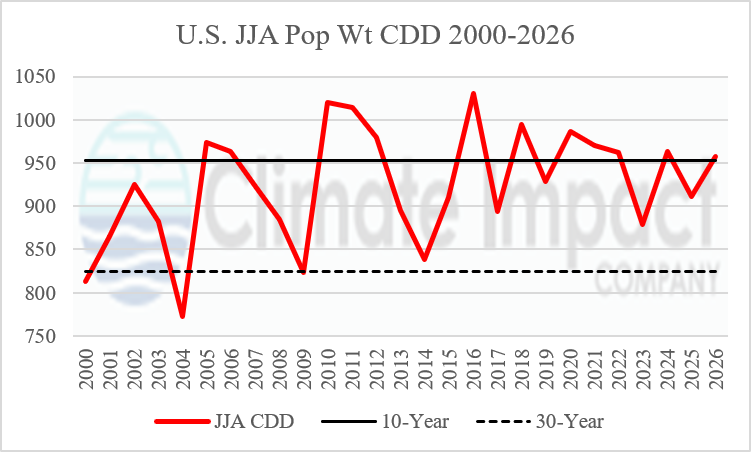
Fig. 3: U.S. population weight CDD totals for JUN/JUL/AUG 2000-2026 compared to 30-year/10-year normal.
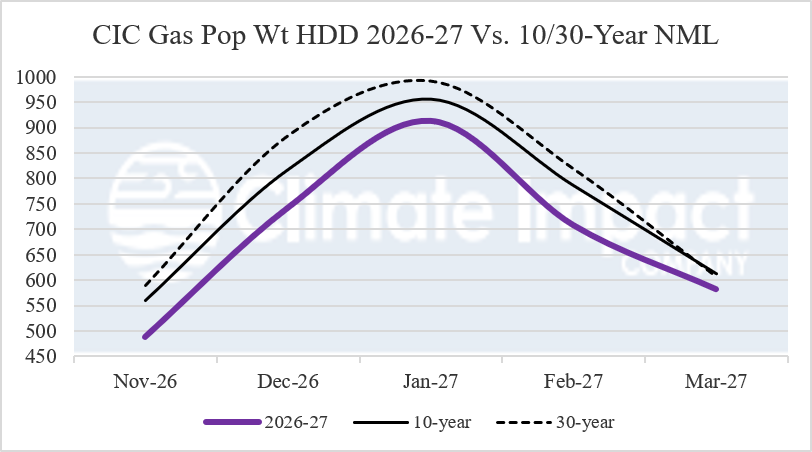
Fig. 4: U.S. gas population weight HDD forecast for NOV-26 to MAR-27 heating season compared to the 30-year/10-year normal.
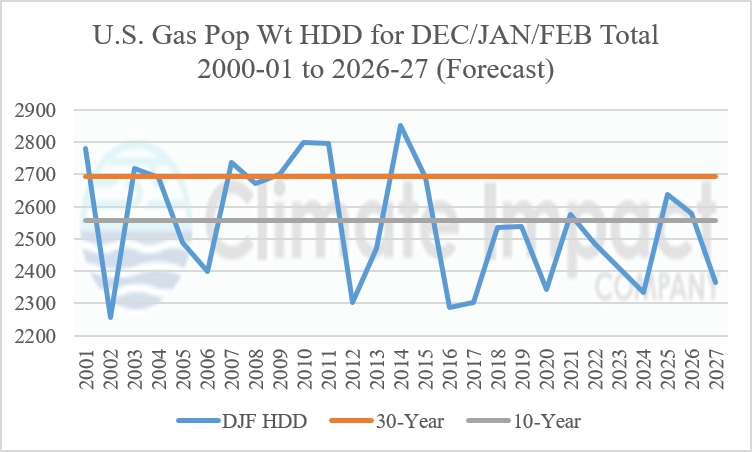
Fig. 5: U.S. gas population weight HDD forecast for 2026-27 compared to previous years dating back to 2000-01.
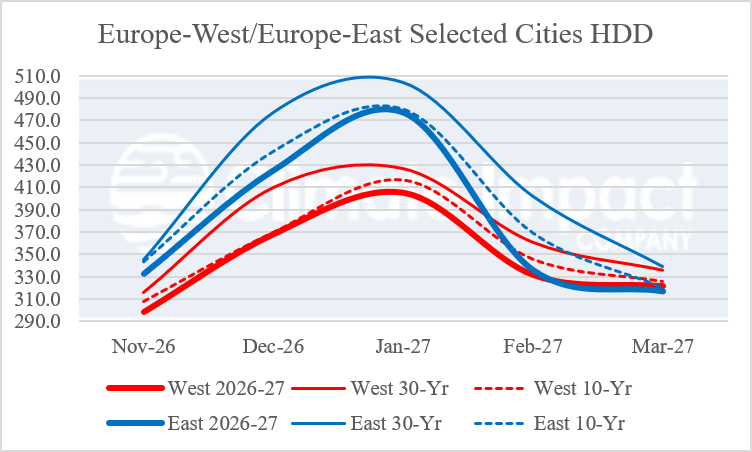
Fig. 6: East and West Europe selected cities HDD forecasts for the NOV-26 to MAR-27 cold season compared to 30-year/10-year normal.