
Record Heat May Develop in Australia
10/08/2025, 5:59 am EDT
Pattern Change Eastern U.S. Later October
10/13/2025, 4:47 pm EDT
Climate Impact Company Tropical Feature
Issued: Thursday October 9, 2025
Highlight: Caribbean/Gulf subsidence/dry air suppressed North Atlantic seasonal tropical cyclone activity.
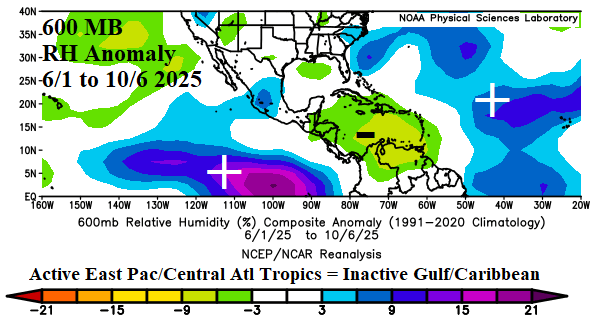
Fig. 1: The 600 MB relative humidity anomalies for the East Pacific and North Atlantic basin tropics and subtropics.
Discussion: So far, the Caribbean Sea has not observed a tropical cyclone in 2025 while only 1 tropical cyclone formed in the Gulf of Mexico. The last time each basin was inactive to this extreme were during strong El Nino years (1997, no activity in The Caribbean and 2015, 1 tropical cyclone in the Gulf of Mexico). Part of the explanation is the mid-troposphere anomalous dry air strongly identified in the Caribbean Sea since June (Fig. 1). The dryness is partially recognized in the Gulf of Mexico. The mid-tropospheric dryness, and attendant subsidence, is compensation for stronger vertical motion and a soaking wet mid-troposphere ideal for tropical cyclone development in the west-central/central North Atlantic and East Pacific tropics and subtropics. In these wet zones, tropical cyclones have flourished featuring 18 East Pacific named storms (14.5 is normal) while most of the North Atlantic activity (9 of 10 storms) occurred in the deep tropics to the west-central North Atlantic basin (Fig. 2-3).

Fig. 2: According to Earthstar Geographics, the East Pacific basin tropical cyclone tracks for 2025 so far.
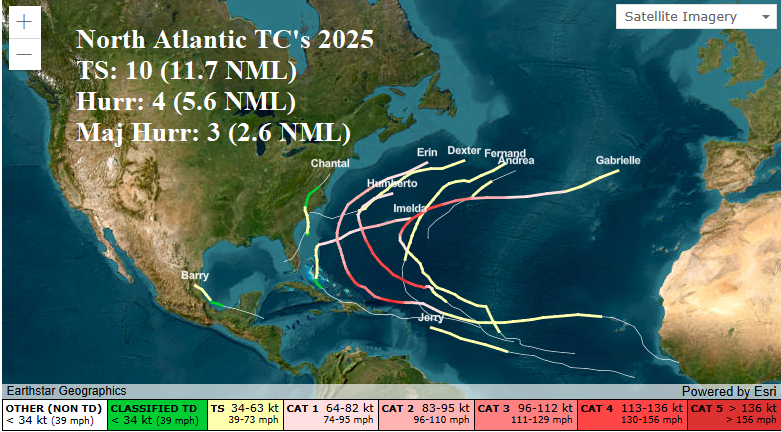
Fig. 3: According to Earthstar Geographics, the North Atlantic basin tropical cyclone tracks for 2025 so far.