
The New Cool Phase Pacific Decadal Oscillation
09/29/2026, 8:35 am EDT
October 2026 Global Soil Moisture Report
10/05/2026, 2:09 pm EDT
Climate Impact Company Monthly Marine Heatwaves Report
Issued: Wednesday September 30, 2026
Highlight: Marine heatwave global oceanic aerial coverage is likely to break a record by late 2026.
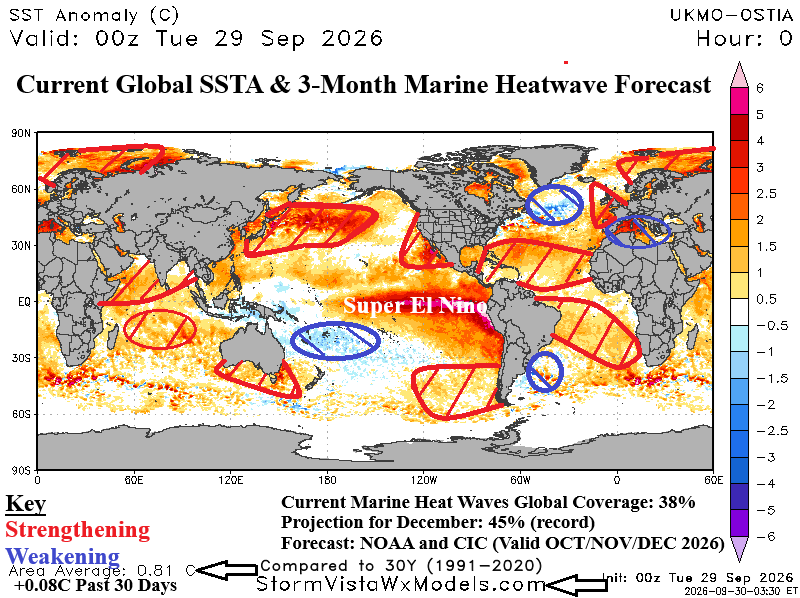
Fig. 1: Daily global sea surface temperature anomalies analysis and annotated 3-month marine heatwave forecast.
Discussion: Currently, global oceanic aerial coverage of marine heatwaves (MHW) is 38% which is an increase of about 13% from early this year (Fig. 1). NOAA states that by late December, the (global) value increases to a record 45%. There are many (already) large MHW’s forecast to strengthen during Q4/2026. Included is the Kuroshio MHW expected to intensify northeast of Japan and strongly support a warmer than normal winter climate for Japan. MHW NEP25A off the southwest coast of North America expands northward and includes coastal Oregon and Washington. The warming ocean surface will add fuel to El Nino-driven “atmospheric rivers” this winter season. The tropical North Atlantic, including the Caribbean Sea, warms during Q4/2026 adding to the already anomalous warm subtropics. MHW’s off the Southwest and North Coast of Europe expand and strengthen during late 2026 adding a warm bias to the European winter climate. The North Atlantic warm hole (NAHW) south of Greenland will strengthen while the torrid Mediterranean MHW weakens during Q4/2026. Broad oceanic warming is likely in the tropical Indian Ocean northward which may weaken the anticipated positive phase signal of the Indian Ocean dipole (+IOD). MHW’s strengthen off the south and southeast coast of Australia while northeast of Australia SSTA’s will cool. The climate pattern correlated to the combination of cool and warm SSTA near Australia is a wet bias for late spring/early summer hopefully slowing recent drought development. MHW’s are (also) forecast to develop southwest of South America and to the east of Brazil while cool SSTA strengthens east and southeast of Uruguay. The SSTA combination off the East Coast of South America supports wet climate primarily focused on Southeast Brazil (while areas to the north are dry).