
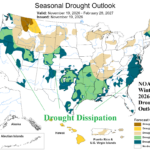
Latest NOAA/CPC Long-lead Forecast for Winter
11/19/2026, 11:55 am EST
Climate Impact Company Monthly Marine Heatwaves Report
Issued: Thursday November 20, 2026
Highlight: Record aerial coverage of global marine heatwaves expected to increase during boreal winter.
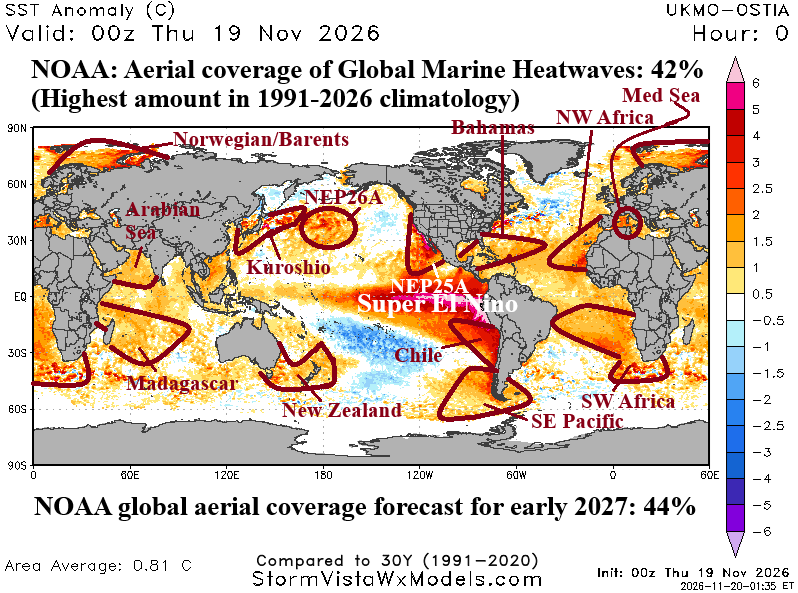
Fig. 1: Daily global sea surface temperature anomalies analysis and annotated location of marine heatwaves.
Discussion: According to NOAA, global aerial coverage of marine heatwaves (MHW) has reached 42% according to a mid-November report which is the highest amount in the 1991-2026 period of record. The 3-month forecast valid during boreal winter is an increase to 44%. 2026 has already produced a record warm global sea surface temperature (SST), part of an ongoing trend of accelerating warmth observed during the past decade.
Effects on climate by major MHW’s of 2026 have been NEP25A off the Southwest Coast of North America linked to the warmest year on record for the Southwest U.S., the Mediterranean Sea and Southwest Europe/Northwest Africa MHW linked to the Europe summer MHW, and the El Nino-related MHW responsible for heavy rain in Chile. MHW’s across the Norwegian and Barents Sea will undoubtedly modulate the effectiveness of North Atlantic oscillation (NAO) during the winter season. Notably, despite record MHW presence, the dominant Kuroshio and NEP26A MHW’s have weakened.
In the southern hemisphere, MHW’s near Madagascar, Australia to New Zealand, and southwest of South America are forecast to strengthen during austral summer. Large subtropical MHW’s increase the risk of stronger than normal high-pressure areas which, when extending across a land mass, cause anomalous heat and drought. When areas of low pressure move across MHW’s, such as a tropical cyclone, over-achieving excessive rainfall episodes are likely.
In 2027, based on most global SSTA forecasts, both the Indian and Atlantic Ocean(s) are forecast to strengthen their warmest basin SSTA on record.