
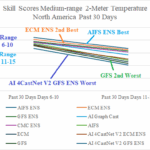
Operational/AI Model Verification Report, North America, Past 30 Days
01/04/2026, 1:05 pm EST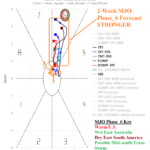
Impactful Convection Phase of the Madden Julian Oscillation is Ahead for Mid-January
01/06/2026, 4:27 am EST
Climate Impact Company Madden Julian Oscillation Outlook
Issued: Monday, January 5, 2026
Highlight: MJO activates; High impact weather implied.
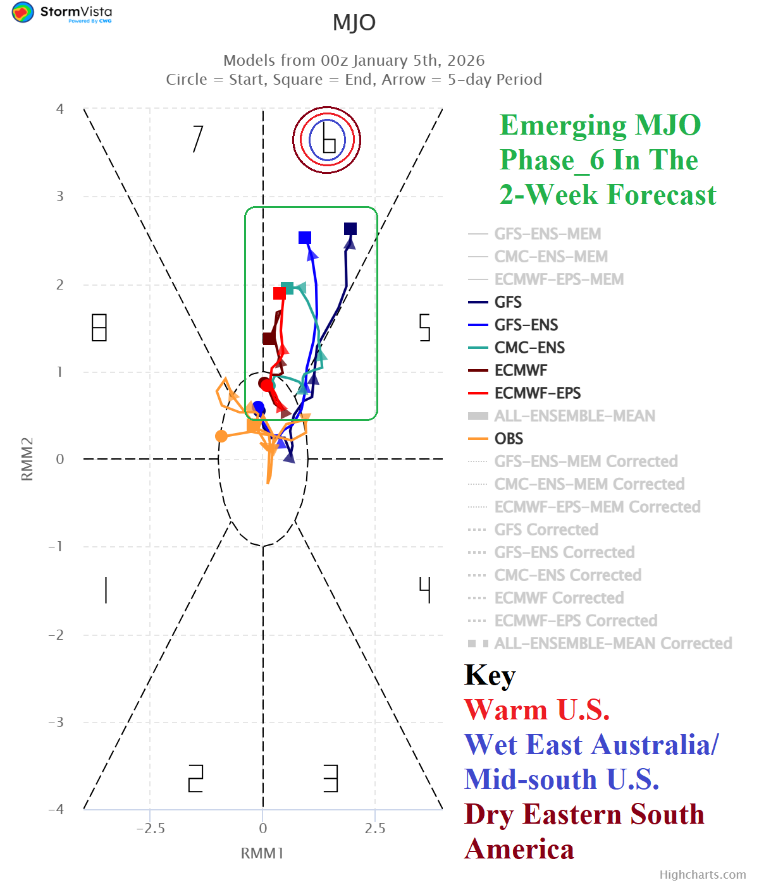
Fig. 1: The 2-week Madden Julian oscillation forecast utilizing all operational models indicates emergence in phase_6 (Maritime Continent toward the Dateline).
Discussion: The last pulse of convection phase Madden Julian oscillation (+MJO) was observed during November across the eastern tropical Indian Ocean to north of Australia. The event was immense, causing many late season tropical cyclones, and eventually a latent heat release poleward to the polar stratosphere. In December, the warming stratosphere shifted over Canada igniting an arctic outbreak.
Since that time, MJO has been dormant. However, in a forecast change, the 2-week MJO forecast utilizing all models indicates a moderate intensity phase_6 of the +MJO develops (Fig. 1) which will cause several important impacts on weather and climate.
Historically, MJO phase_6 causes a robust warm signal in the U.S. Certainly, the anomalous warmth is forecast through the next 10+ days. However, the following expected colder shift could be delayed if MJO phase_6 continues. Additionally, MJO phase_6 strongly supports a heavy rain event in the Mid-south U.S. Midday models indicate a gathering trajectory of tropical moisture from the Southeast Pacific into Mexico which could easily extend farther north and into the U.S. A heavy rain/major storm event may be ahead for 2 weeks from now in the Mid-south region (with cold to follow).
MJO Phase_6 supports wet weather in eastern Australia and dry weather across eastern South America.
MJO phase_6 could be stronger than usual given the subsurface equatorial Pacific warm water shifting east of the Dateline. The combination of MJO moving across waters where the Kelvin Wave is located will cause La Nina to end.