
ENSO Remains Neutral; Subsurface is Bubbling Hot!
03/30/2026, 1:52 pm EDT
Immense Subsurface Kelvin Wave East of Dateline Promises Intense El Nino Ahead in 2026
04/13/2026, 12:03 pm EDT
April 2026 Climate Impact Company ENSO Outlook
Upper ocean heat expected to accelerate in April/May providing ample fuel to ignite a strong El Nino in 2026!
Executive summary: Suddenly, an immense Kelvin Wave has emerged just east of the Dateline in the equatorial Pacific Ocean likely to shift eastward during the next several weeks and accelerate upper ocean heat to fuel El Nino onset. The rate of expected warming is similar with the strongest El Nino’s on record in 2015 and 1997. Analogs and dynamic models are supportive of a potential record strength El Nino in 2026. Given the accelerating oceanic warming of the past 1-2 decades, El Nino will likely cause the warmest global ocean temperature on record in 2026.
Discussion: Emergence of a new Kelvin Wave just east of the Dateline at 100-250 -meter depth (Fig. 1) is accelerating upper ocean heat (Fig.2). Dynamic models have been forecasting a potential record-strength El Nino in 2026 (Fig. 3). The dramatic warming of the subsurface substantiates the claim. The upper ocean heat began in January, accelerated in February, and continued to increase in March (Fig. 4). Given the rapidly developing Kelvin Wave, the April upper ocean heat value will accelerate. Using the upper ocean heat anomalies for JAN-MAR and projected APR value, similarities are evident with the first third of the year when the strongest El Nino episodes of the past 45 years have developed. Similarly, the attendant Nino34 SSTA for El Nino years 1982, 1997, 2015, and 2023 are running close to 2026. However, the expected acceleration in APR upper ocean heat and Nino34 SSTA warming most closely match the all-time strongest El Nino events of 1997 and 2015 (Fig. 5-6). Based on subsurface heating, i.e. potential energy, analogs indicate expectations of a possible record setting El Nino in 2026 is possible.
The immense Kelvin Wave also provides clues as to when El Nino onset will occur. Currently, Nino34 SSTA is neutral and while southern oscillation index (SOI) was recently negative, a consistent El Nino-generating -SOI is uncertain for April. Once the eastward shifting Kelvin Wave reaches the northwest coast of South America, dramatic and rapid warming of the eastern equatorial Pacific Ocean occurs, and El Nino onset should arrive in May.
During the past 1-2 decades, global oceanic warming has accelerated. The warming is accounted for by increasing frequency and strength of marine heatwaves (MHW). Oceanic warming is away from the tropics and research has revealed influencing ENSO regimes. Specific effects are not well-defined (yet). The 2023 and 2015 El Nino episodes occurred with elevated global oceanic warming unlike preceding El Nino events. Therefore, considerable influence on climate forecasts for 2026 include 2023 and 2015.
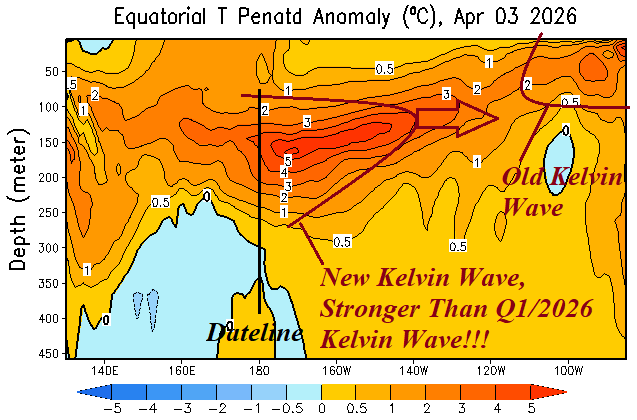
Fig. 1: The upper ocean heat anomalies across the equatorial Pacific Ocean including a new and potent Kelvin Wave just east of the Dateline.
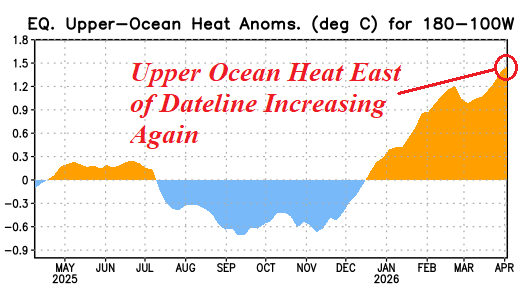
Fig. 2: Upper ocean heat increase has resumed and based on the emerging Kelvin Wave east of the Dateline could accelerate mid-to-late April.
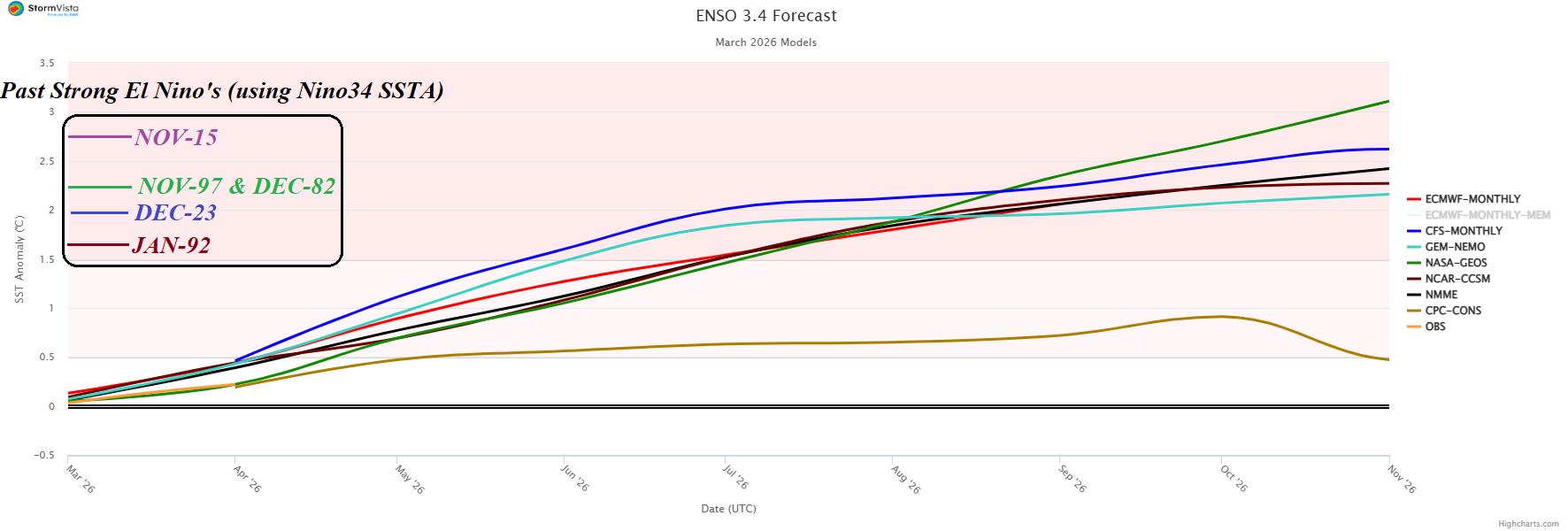
Fig. 3: Set of dynamic models forecasting the Nino34 SSTA are generally agreeable to a strong El Nino in 2026 challenging peak strength of past El Nino’s.
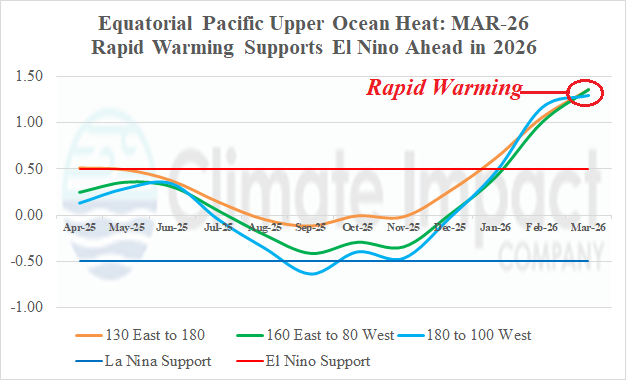
Fig. 4: Monthly upper ocean heat anomalies for the past 12 months in the equatorial Pacific Ocean.
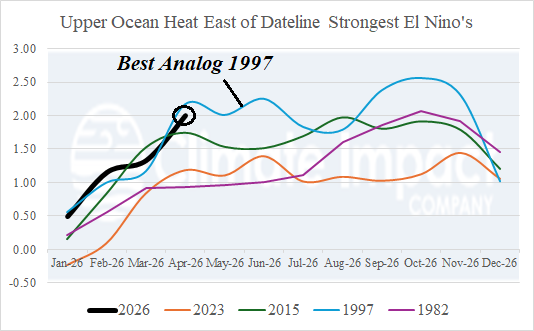
Fig. 5: The Nino34 SSTA for JAN-APR of each strong El Nino during the past 45 years suggests a strong El Nino for 2026, similar with 1997.
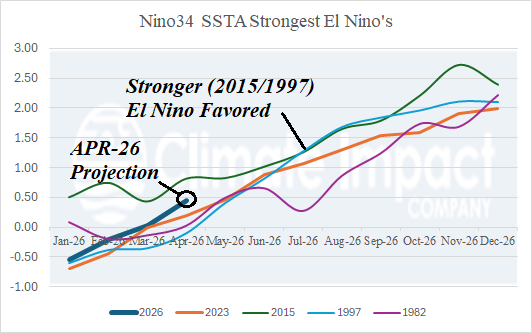
Fig. 6: Utilizing upper ocean heat anomalies across the equatorial Pacific Ocean east of the Dateline, the APR-26 projection implies the stronger El Nino episodes of 2015 and 1997 are the best analogs.