
Turning Colder into Early January Europe
12/12/2025, 9:49 am EST
High Wind Is Precursor To The “Atmospheric River” Pattern
12/17/2025, 8:20 am EST
Climate Impact Company Early AG Market ALERT
Issued: Tuesday December 16, 2025
Highlight: Multi-variate ENSO index returns! Identifies well established La Nina climate!
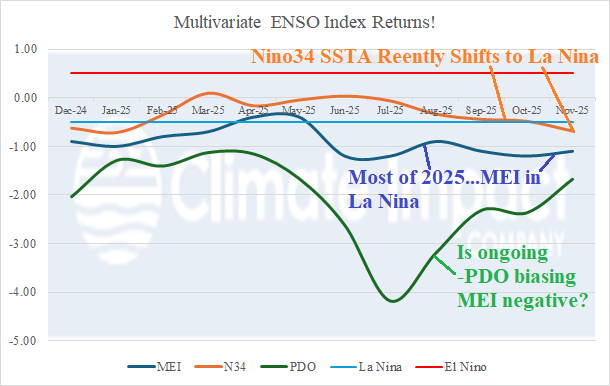
Fig. 1: The 12-month monitoring of the Nino34 SSTA index, multi-variate ENSO index, and Pacific decadal oscillation.
Discussion: An important climate diagnostic, missing since last April, has returned this month: Multivariate ENSO index (MEI). The MEI identifies the response of the atmosphere (30S to 30N) to the Pacific equatorial sea surface temperature anomaly (SSTA) regime. Note that the conventional climate diagnostic to identify ENSO phase, the Nino34 SSTA, only recently shifted to La Nina (Fig. 1). A La Nina regime is indicated by MEI all but APR and MAY of the past 12 months. Consequently, the prevailing ENSO climate of 2025 has been La Nina while oceanic ENSO was mostly neutral phase. One possible contributor to the MEI La Nina bias is the ongoing vigorous cool phase of the Pacific decadal oscillation (-PDO) common when La Nina is present. The agreeable La Nina indices are notably causing precipitation regimes to follow La Nina climatology in North America, South America, and Australia. Wet La Nina climate bias is vigorous across the Northwest U.S. to finish December (Fig. 2). The wet La Nina climate bias for the northern half of South America is vividly displayed in the latest 15-day outlook (Fig. 3). Additionally, a wet pattern in Australia is expanding, mostly driven by La Nina influences (Fig. 4).
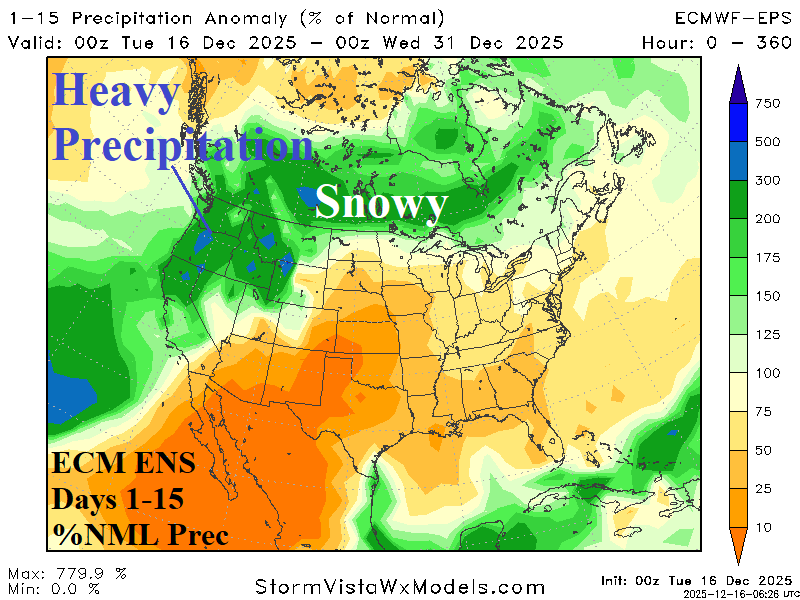
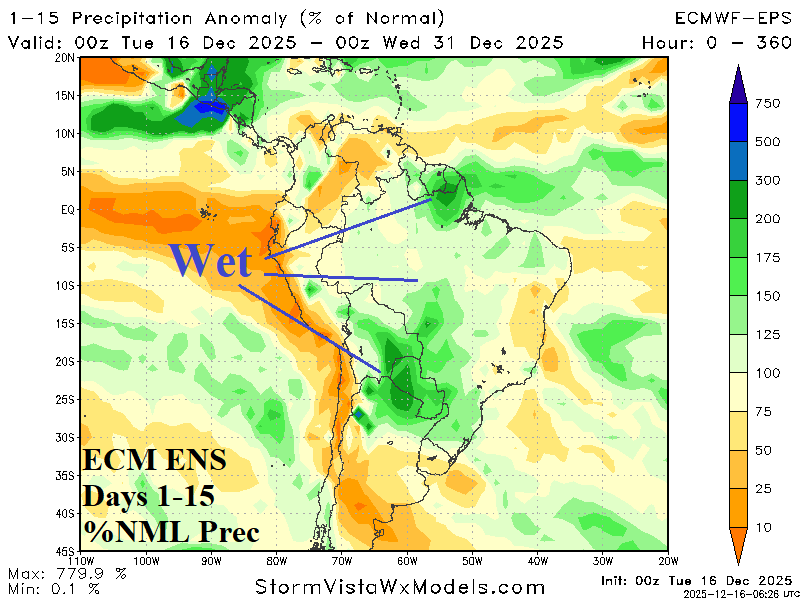
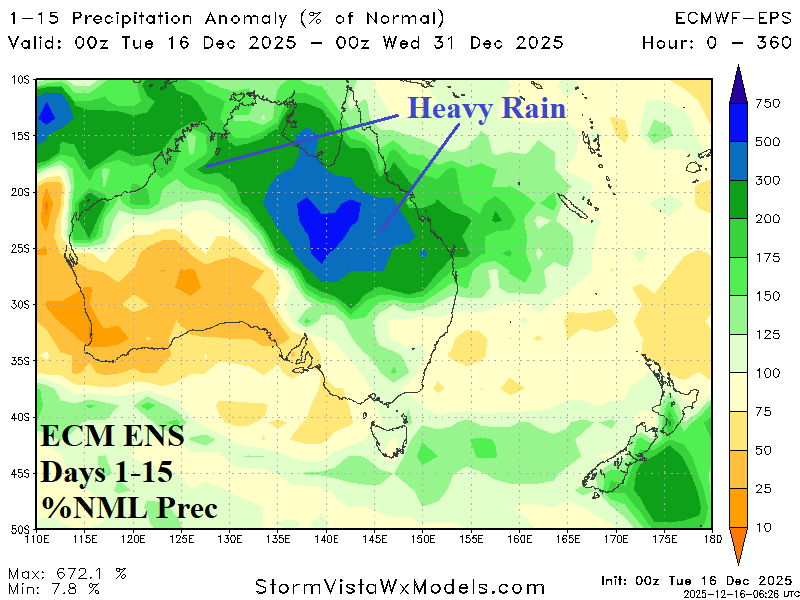
Fig. 2-4: ECM ENS 15-day percent of normal precipitation forecasts for North America, South America, and Australia.