
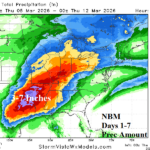
U.S. Severe Storms/Flooding Rainfall
03/05/2026, 5:39 am EST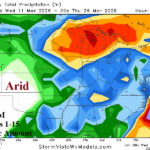
Dry Concerns West/Southwest Great Plains Emerging
03/11/2026, 4:44 am EDT
March 2026 Climate Impact Company ENSO Outlook
Using upper ocean heat, Nino34 SSTA, and southern oscillation index constructed analog for 2026-28 ENSO forecast…Big El Nino in 2026 followed by returning La Nina in 2027.
Executive summary: Climate Impact Company combines equatorial East Pacific upper ocean heat anomalies, Nino34 SSTA, and southern oscillation index analog years to project ENSO phase for March 2026 through February 2028. The results are heavily considered in climate forecasts issued around the globe on month 1-4 ahead, season 1-4 ahead, and 2-year ahead timescales. The forecast projects El Nino development during Q2/2026 followed by a potentially strong El Nino evolving during Q3/2026. The 2026 El Nino event dissipates early next year and is followed by La Nina returning mid-to-late next year lasting into early 2028. ENSO influence on global climate, coupled with already near record warm ocean waters away from the tropics, will be significant during the next 2 years. Of note, we are within the core of the springtime ENSO predictability barrier. Forecasts are made with caution with increased confidence in 1-2 months.
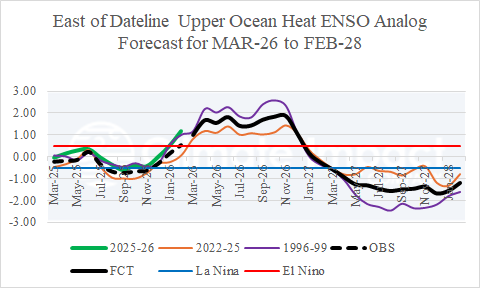
Fig. 1: The Climate Impact Company constructed analog forecast of ENSO phase for MAR-26 to FEB-28 utilizing upper ocean heat anomalies east of the Dateline.
Climate Impact Company constructed analog forecasts: The Climate Impact Company MAR-26 to FEB-28 ENSO phase forecast is based on a constructed analog utilizing upper ocean heat anomalies east of the Dateline (Fig. 1), Nino34 SSTA (Fig. 2), and southern oscillation index (Fig. 3). The upper ocean heat in the eastern equatorial East Pacific became immense during February and is the leading indicator of El Nino risk ahead. Only 2 analogs from the past 30 years match the 12-month regression: 2022-23 and 1996-97. In both cases moderate to strong El Nino emerged in the current year, dissipated early the following year, and was followed by a compensating vigorous La Nina beginning Q2/2027. The (conventional) Nino34 SSTA index utilizes 4 analogs all agreeable to El Nino ahead but with varying intensity. The constructed analog indicates weak La Nina follows the second half of 2027. The southern oscillation index forecast utilizes the Nino34 analogs, and the consensus view is weak El Nino ahead for 2026 followed by weak La Nina in 2027. In summary, the Climate Impact Company constructed analog forecast is agreeable to El Nino ahead in 2026 followed by La Nina in 2027 although the intensity level of each ENSO regime is uncertain. Given the outlook, ENSO influence on global climate is sizeable for the next 2 years likely with opposing character from one year to the next.
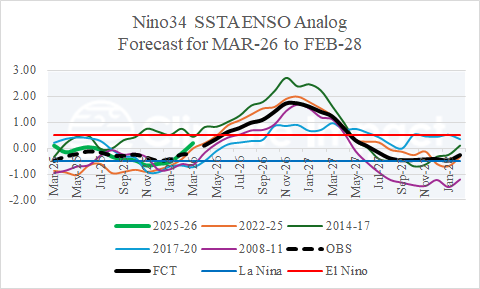
Fig. 2: The Climate Impact Company constructed analog forecast of ENSO phase for MAR-26 to FEB-28 utilizing the Nino34 SSTA.
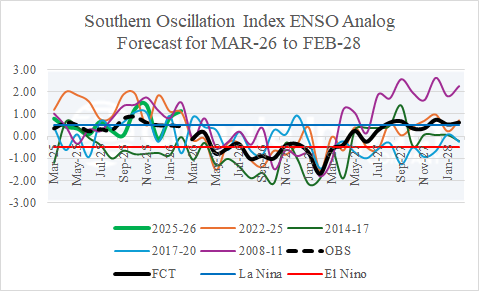
Fig. 3: The Climate Impact Company constructed analog forecast of ENSO phase for MAR-26 to FEB-28 utilizing southern oscillation index.
Current ENSO diagnostics: Remember, we’re at the core of the ENSO predictability barrier therefore caution is recommended on ENSO-related climate forecast planning until mid-to-late Q2/2026. The (daily) conventional Nino34 SSTA is exactly normal, warming by 0.4C during the past month. The (daily) southern oscillation index is +2.5 which vigorously endorses a lingering La Nina climate. Despite an active Madden Julian oscillation, the southern oscillation index has been in a La Nina-like positive phase most of the past 3 months. Subsurface warming of the equatorial East Pacific is immense and the reason for dynamic models each indicating El Nino ahead. The long-standing positive southern oscillation index is forecast to ease to neutral phase after mid-month in response to a transient Pacific Madden Julian oscillation. At that time, trade winds should weaken and allow possible acceleration of the warming of the Nino34 SSTA. In summary, at face value, upper ocean heat strongly supports El Nino ahead. However, while the ocean is warming, the atmosphere has yet to respond. Shift of southern oscillation index to a lengthy negative phase and significant warming of Nino34 SSTA is required to justify the El Nino forecasts which have not generated (yet).
ECMWF, CFS V2, and POAMA forecasts: Dynamic models recognize the subsurface warming of the East Pacific equatorial region and steadily project emerging El Nino (quickly) during Q2/2026 (Fig. 4). Each dynamic model projects a strong El Nino during Q3/2026. The Climate Impact Company constructed analog is not quite as strong.
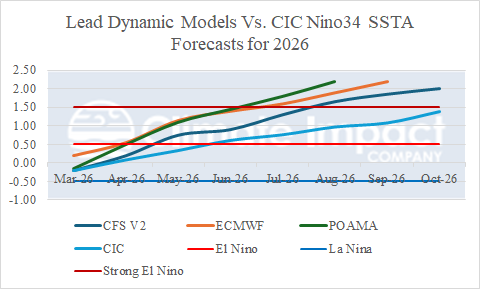
Fig. 4: Collection of leading dynamic model Nino34 SSTA forecasts compared to the Climate Impact Company constructed analog.
Implications: The Climate Impact Company constructed analog climate forecasts for months 1-4 ahead, season 1-4 ahead, and year-2 ahead will heavily reflect the projected El Nino climate for 2026 reversing back into a La Nina climate later next year. Please see these outlooks for details for all sectors of the globe.