
At The Surface, La Nina Strengthened Last Week. However, Subsurface Cool Fuel Diminishing.
12/15/2025, 4:07 pm ESTSouth/Southeast U.S. Drought Expansion; La Nina Climate Through Q1/2026
12/18/2025, 9:40 am EST
Climate Impact Company Daily Feature
Issued: Tuesday, December 16, 2025
Highlight: When does the stratosphere warm again?
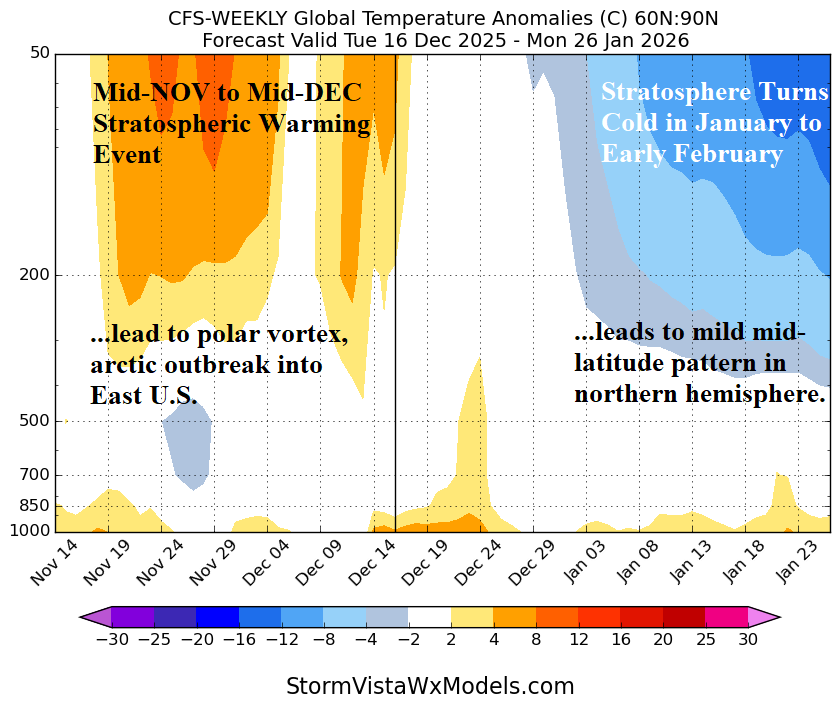
Fig. 1: The CFS V2 global temperature anomaly forecast for the troposphere and lower stratosphere.
Discussion: The stratospheric warming event of mid-November to mid-December is dissipating (Fig. 1). The warming event took place on the American side of the North Pole and spawned a polar vortex in North America causing the early meteorological winter 2025-26 arctic outbreak across the eastern states. Forecast models indicate the cold stratosphere across Eurasia expands cross-polar into North America later this month. Based on the NCEP CFS V2 temperature anomaly forecast for the lower stratosphere, late December 2025 colder trend strengthens and intensifies in January. The cold peak is beginning at the end of the 6-week forecast in late January. Consequently, reasonable is to expect a cold stratosphere to develop in January, peak late month, and not weaken until middle third of February. Arctic air generated by stratospheric warming is limited during mid-winter.
The NOV/DEC stratospheric warming event was driven by a potent convection phase of the Madden Julian oscillation (MJO) stretched across Maritime Continent. The latent heat release by a massive area of thunderstorms poleward and upward into the stratosphere caused the warming on the Pacific side of the North Pole. Intense MJO events can create conditions that lead to stratospheric warming. Monitoring the MJO for the next intense event, usually occurring over the tropical West Pacific where ocean temperatures are warmest, is paramount as to timing the next potential stratospheric warming. MJO frequency is 6 weeks therefore the next MJO-driven stratospheric warming event is around February 1st.
Stratospheric warming can also be produced by intense solar flares. Currently, the sunspot activity is diminishing as solar cycle peak 25 is behind us, and we’re heading toward solar minimum in 2030-31.
Easterly phase of the quasi-biennial oscillation (-QBO) is considered an upper atmospheric condition more favorable to stratospheric warming events. While recently published research did not disagree with the theory, the research did show that modeling the concept is difficult.