

East Pacific Surface Warms Slightly; Subsurface Warming Eases Back Slightly
01/20/2026, 12:54 pm EST
Out Of Control U.S. Cold Including A Double Dip Across ERCOT
01/22/2026, 12:36 pm EST
Climate Impact Company Daily Feature
Issued: Wednesday, January 21, 2026
Highlight: January to February AO precedent; AI HDD forecasts
Discussion: The daily arctic oscillation (AO) spikes to a whopping -5 early next week and very supportive of the coldest late January on record for this century across the Central and East U.S. The projected AO value for JAN-26 is -2.2, possibly stronger. The last 4 months of January with similar strong negative phase signatures are 2021, 2010, 2004, and 1998 (Fig. 1). -AO was maintained the following February (except 1998). The FEB -AO analog years indicate another cold month with a strong South/East storm track (Fig. 2-3).
The U.S. HDD outlook in today’s week-4 outlook is colder than normal utilizing a consensus between AI 4CastNet V2 ECM ENS, AI 4CastNet V2 GFS ENS, and AI Graph Cast ECM ENS (Fig. 4). The CFS V2/ECM consensus is warmer. Of interest is the record strength 295 HDD forecast for the last week of January from overnight compared to week-4 forecasts made earlier this month. AI was much colder than the CFS V2/ECM consensus (Fig. 5).
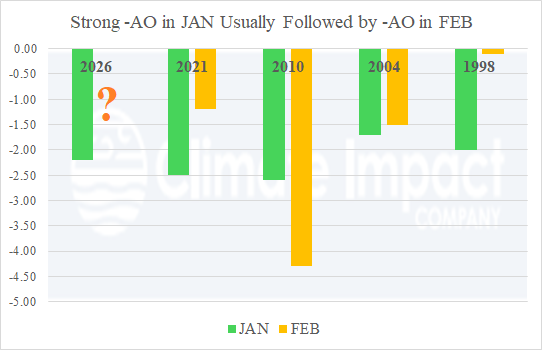
Fig. 1: Negative arctic oscillation in January and what (historically) follows in February.
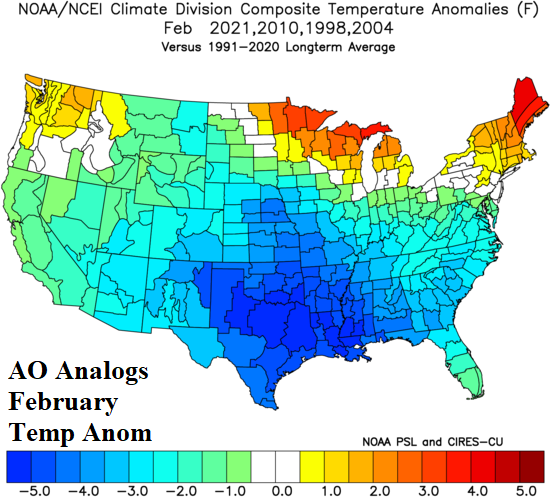
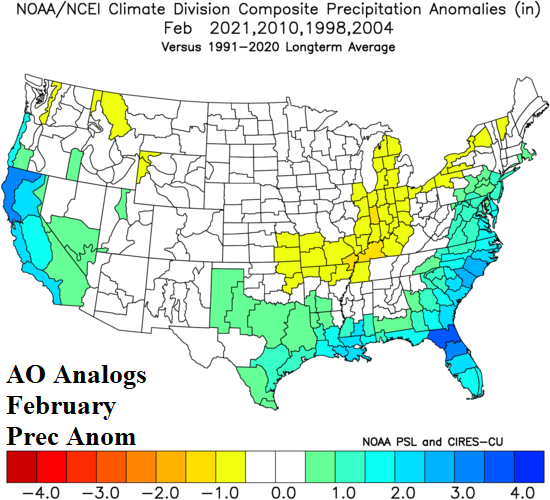
Fig. 2-3: Arctic oscillation analog years temperature and precipitation anomalies for February.
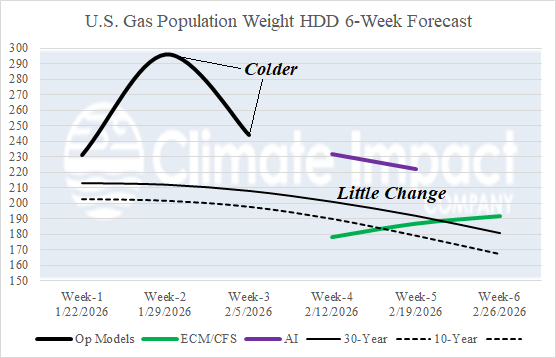
Fig. 4: The overnight 6-week U.S. gas population weight HDD forecast utilizing all models through February 5th and estimated for week 4-6 based on a CFS V2/ECM consensus and 3 AI models consensus.
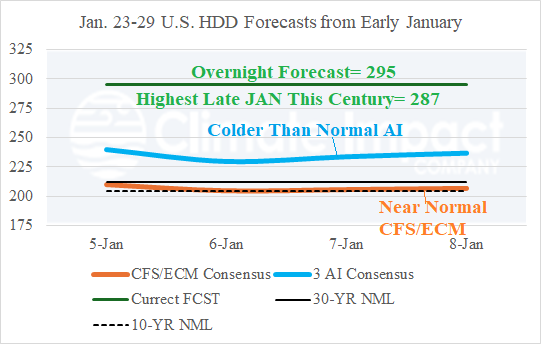
Fig. 5: The projected HDD from overnight for Jan. 23-29 compared to week forecasts made in early January by CFS V2/ECM consensus and 3 AI models consensus.