
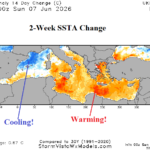
Mediterranean Sea Marine Heatwave Shifting East, Should Influence Upper Air Pattern Later June
06/09/2026, 11:19 am EDT
June 2026 Climate Impact Company ENSO Outlook
Issued: Thursday June 11, 2026
NOAA announces presence of El Nino conditions. Possible record strength oceanic El Nino in 2026 but ENSO climate may be less intense.
Executive summary: Traditional measurements of ENSO phase indicated El Nino onset during early Q2/2026. However, the new relative operational Nino index (RONI) is (now) used to determine ENSO strength and forecasts. Using RONI, NOAA identifies the presence of El Nino beginning in June. Dynamic models continue to forecast a potential record strength oceanic El Nino likely due to the immense upper ocean heat rivaling the 1997-98 El Nino as most intense on record. However, using a RONI analog, the ENSO climate may be less impressive and is followed by La Nina returning next year.
Climate discussion: NOAA announces presence of El Nino conditions at the start of northern hemisphere meteorological summer 2026. Most impressive is the increasingly intense negative southern oscillation index (-SOI) which strongly supports evolution of an El Nino climate. Oceanic ENSO shifted to El Nino several months ago using the conventional Nino34 SSTA but only recently when applying the new relative Nino34 SSTA. Subsurface upper ocean heat in the equatorial East Pacific Ocean rivals the record-strength 1997-98 El Nino episode causal to many dynamic models predicting a possible record strength El Nino for later this year.
The Climate Impact Company June 2026 Monthly ENSO Forecast concentrates on ENSO intensity and what may develop after the 2026-27 El Nino.
Earlier this year, NOAA (and POAMA) introduced relative operational Nino index (RONI) as methodology to eliminate the accelerating oceanic warming of recent decades to make the current ENSO assessment more realistic when compared to historical ENSO events. The statistic de-emphasizes El Nino and enhances La Nina given this change.
Recently, Climate Impact Company identified the close relationship RONI has with multivariate ENSO index (MEI). MEI identifies the atmospheric reaction of tropical/subtropical SST and SLP across the Pacific Ocean which ultimately is the most important part of the ENSO regime. The relationship between RONI and MEI is much closer than the traditional Nino34 SSTA (Fig. 1). Therefore, a RONI analog forecast is appropriate to identify, from a historical perspective, how strong the El Nino climate.
The consensus of RONI analog years taken from the past 3 decades suggests a moderate strength El Nino peaking in November (Fig. 2). RONI shifts ENSO phase to moderate strength La Nina the last third of 2027.
Clearly, the RONI-based analog, representative of El Nino climate strength is considerably less intense than oceanic El Nino forecast at possible record strength by NCEP CFS V2, ECMWF, and POAMA (Fig. 3).
In summary, El Nino has developed. Oceanic El Nino is forecast at possible record strength later this year. However, atmospheric El Nino may be considerably less intense. ENSO phase is forecast to shift back to La Nina in 2027.
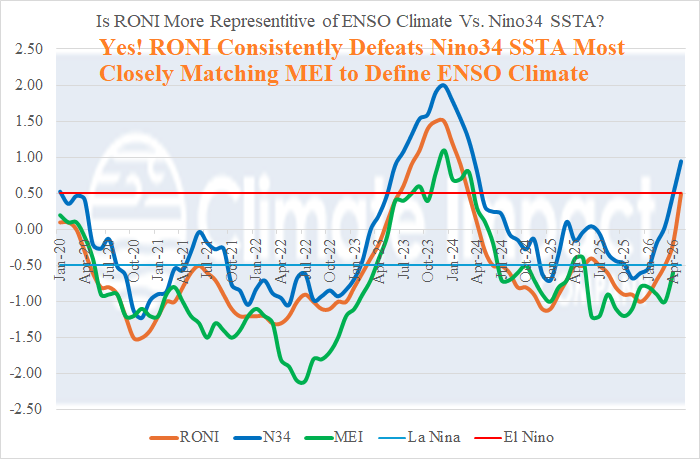
Fig. 1: The new relative operational Nino index (RONI) is reasonably similar to multivariate ENSO index (MEI) during the current decade, much more so than Nino34 SSTA.
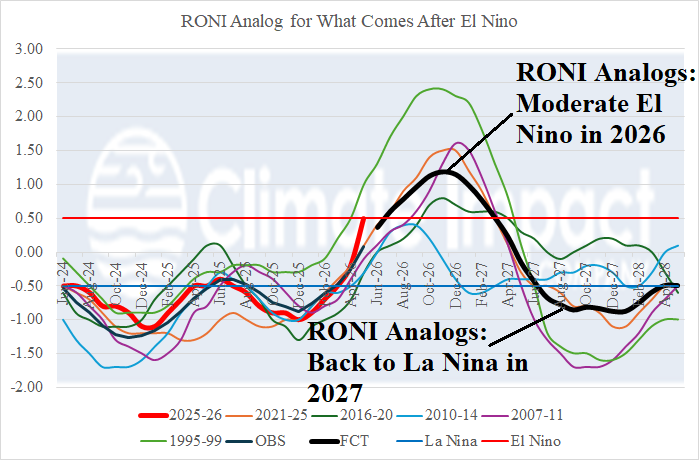
Fig. 2: The RONI analog ENSO phase forecast through middle 2028.
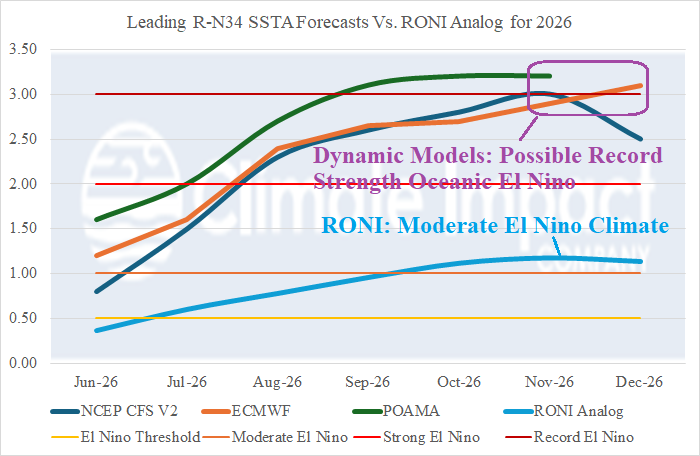
Fig. 3: The RONI analog forecast compared to most recent relative Nino34 SSTA projections using NCEP CFS V2, ECMWF, and POAMA forecasts. Implied is oceanic El Nino is much stronger than atmospheric El Nino.