
Cold Europe/Western Russia Pattern Ahead
01/06/2026, 5:00 am EST
MJO East Shift Brings Wetter Bias to South America Last 1/3 of Month
01/11/2026, 11:54 am EST
January 2026 Climate Impact Company ENSO Outlook
Issued: Thursday January 8, 2026
La Nina ending next 1-3 months confidently forecast. Entering “springtime prediction barrier” indicates mid-to-late 2026 ENSO forecast uncertain.
Executive summary: The equatorial subsurface East Pacific has warmed significantly and oceanic La Nina demise is ahead for late winter. La Nina climate is likely to last longer, lasting until mid-to-late spring. We’re entering the “springtime prediction barrier” for ENSO forecasts. Recent research has revealed that already low skill of ENSO forecasts made at this time of year has worsened. Therefore, the ENSO phase forecast for mid-to-late year is made with low confidence. Climate Impact Company constructed analog forecasts utilizing Nino34 SSTA and MEI are generally settled on neutral ENSO ahead while NOAA probability forecasts indicate El Nino risk by mid-year.
New research and the springtime ENSO prediction barrier: ENSO remains a key contributor to climate forecasting and accounting for past climate regimes. Climate Impact Company (CIC) has noted that in this decade ENSO forecast skill has lowered. Based on observations, the warming of the global oceans has contributed to the lower skill. New research published in Journal of Climate earlier this month reveals that lowering ENSO forecast skill is dated to 2005. According to the research, two sources contributing to increased forecast error include underestimating warmer oceanic surface currents and less skillful upper ocean heat regimes. Combining improved physics/dynamic models with machine learning beginning in 2025 is expected to increase skill.
The research concluded that the leading contributor to increased ENSO forecast error occurs during the “springtime prediction barrier” when ENSO is typically in transition. Lowest skill scores are for late spring/early summer from forecasts issued early in the year (Fig. 1). Over the next 2-3 months, forecasts for MAY/JUN/JUL should be used with caution.
Leading climate diagnostics: Right now, the leading climate diagnostic requiring close monitoring is the equatorial East Pacific upper ocean heat. During the past several weeks a warm Kelvin Wave has shifted east of the Dateline with intensity and should reach the northwest coast of South America in a couple weeks (Fig. 2-3). Consequently, oceanic La Nina should weaken considerably in February.
Multivariate ENSO index (MEI) identifies the atmospheric response to sea surface temperature anomalies (SSTA). MEI has anchored in La Nina phase for the past 18 months while the Nino34 SSTA has bounced between neutral ENSO and brief periods of La Nina (Fig. 4). Following the relationship between Nino34 (oceanic) La Nina and MEI (atmospheric) La Nina established in 2024-25, La Nina climate likely lingers longer than oceanic La Nina during the first half of 2026.
ENSO forecasts: Utilizing the 2024-25 ENSO regime, as identified by Nino34 and MEI, constructed analog forecasts reveal neutral ENSO follows La Nina for 2026 (Fig. 5-6). Marginal risks are indicated for a return to La Nina later this year or generation of a weak El Nino. Moving past the “springtime prediction barrier” is required to produce increased reliability.
The NOAA/CPC probabilistic Nino34 SSTA forecast reveals decelerating La Nina over the next 1-3 months followed by neutral ENSO (Fig. 7). The NOAA/CPC probabilistic forecast indicates chance of El Nino for mid-to-late 2026.
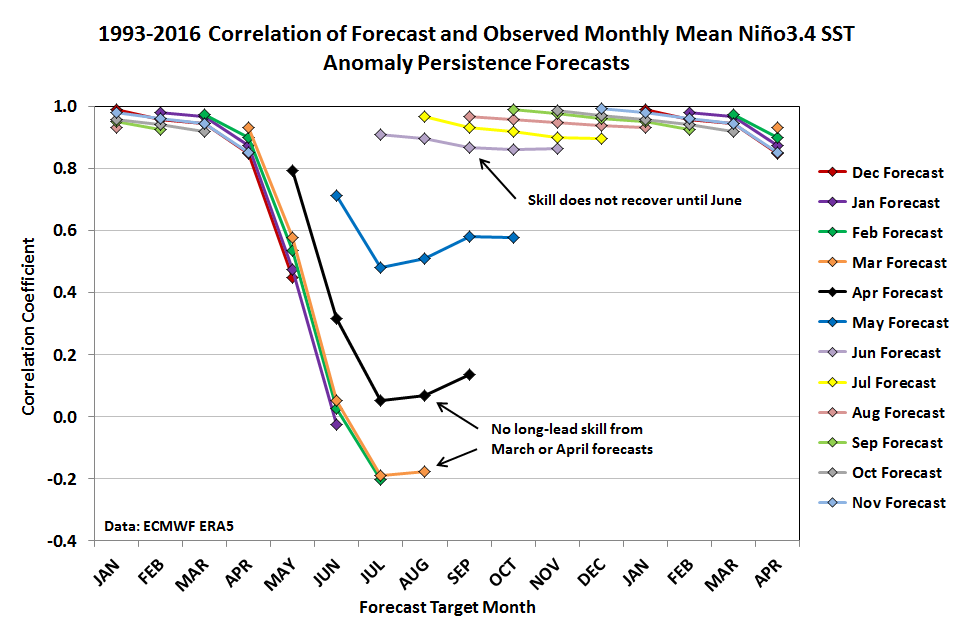
Fig. 1: Forecast skill out to 5 months forecasting Nino34 SSTA lowers considerably during the MAR/APR springtime barrier valid for following months through AUG/SEP. Forecast skill improves dramatically for MAY/JUN.
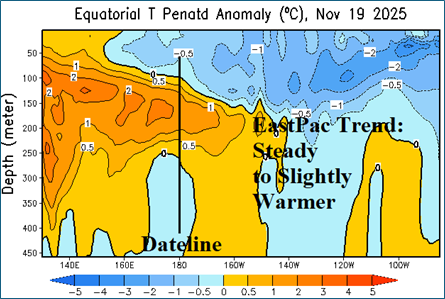
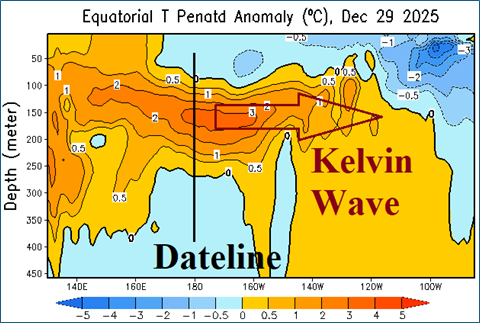
Fig. 2-3: Subsurface equatorial Pacific Ocean upper ocean heat temperature anomalies reveal significant warming of the East Pacific. If the warming reaches the South America Coast and is followed by a second surge of warming during late winter/early spring, El Nino forecasts indicated by NOAA/CPC gain credibility.
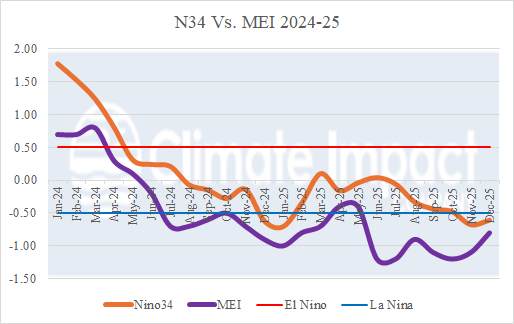
Fig. 4: Comparing Nino34 and MEI to identify oceanic and atmospheric ENSO phase of the past 2 years.
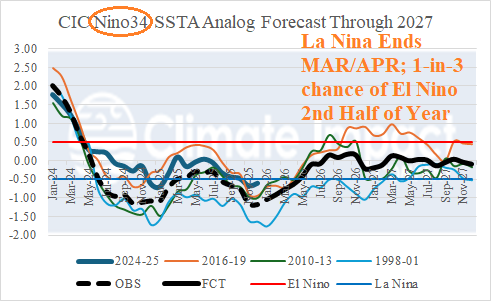
Fig. 5: The Climate Impact Company constructed analog ENSO phase forecast utilizing Nino34 SSTA.
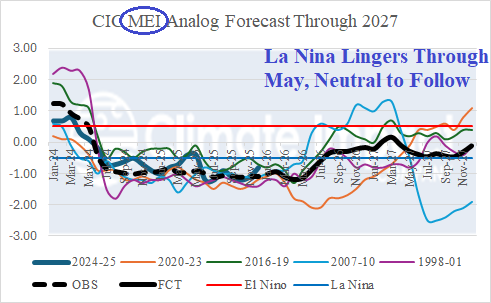
Fig. 6: The Climate Impact Company constructed analog ENSO phase forecast utilizing multi-variate ENSO index.
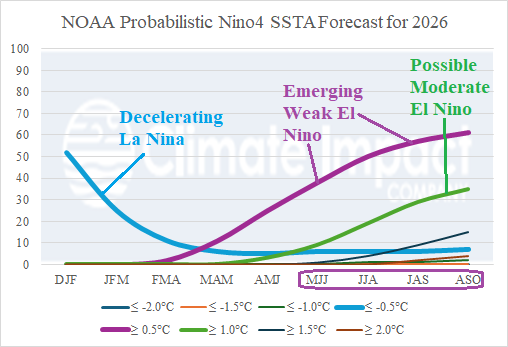
Fig. 7: The NOAA/CPC probabilistic Nino34 SSTA forecast through AUG/SEP/OCT 2026.