

Subsurface Equatorial Upper Ocean Heat Anomalies Dictate IOD/ENSO Ahead
09/04/2025, 5:03 am EDT
Long Duration Dryness Ohio Valley to Southeast U.S. Closes Calendar Summer
09/09/2025, 4:57 am EDT
Climate Impact Company Sunday AG Report
Global Weather/Climate Report
Issued: Sunday September 7, 2025
Highlights: South America and Australia spring outlook review. The Ohio Valley/East Corn Belt drought. Europe/Black Sea drought update.
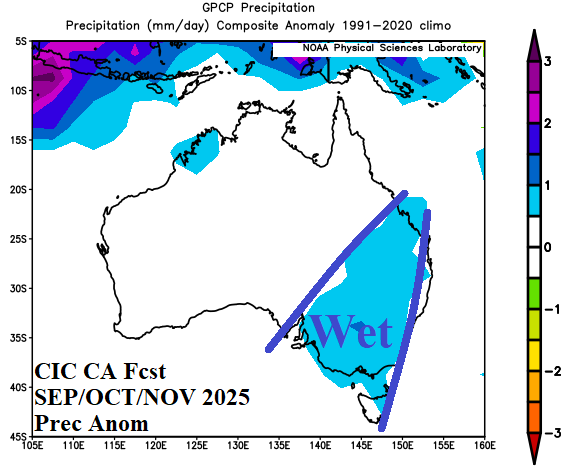
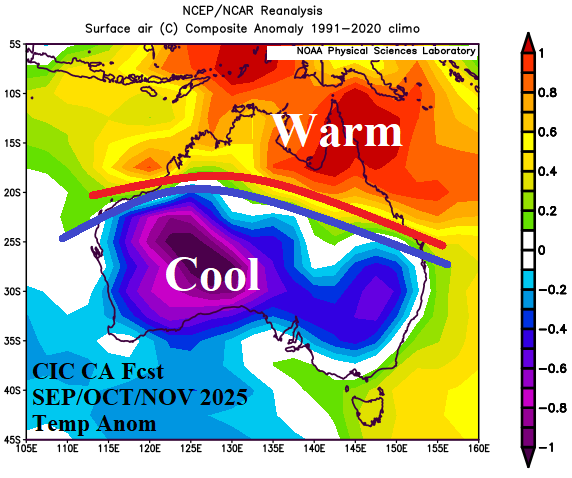
Fig. 1-2: Climate Impact Company constructed analog forecast of temperature and precipitation anomalies for meteorological spring 2025 across Australia.
Discussion: As a review, the spring 2025 season in Australia is confidently projected wetter than normal across eastern continent while the southern half of the continent is cooler than normal (Fig. 1-2). The North Coast is somewhat warmer than normal. In South America, a drier than normal projection is indicated with average confidence stretching from Peru to Bolivia to Northeast Argentina and Southeast Brazil (Fig. 3). A wet regime is likely across northern continent to Northeast Brazil. Anomalous heat builds across northern continent to Central Brazil and across North Chile (Fig. 4). The outlooks are based on an analog whereas La Nina and negative Indian Ocean dipole (-IOD) are present during spring coupled with large marine heat waves east of Argentina and east of Australia and New Zealand (Fig. 5).
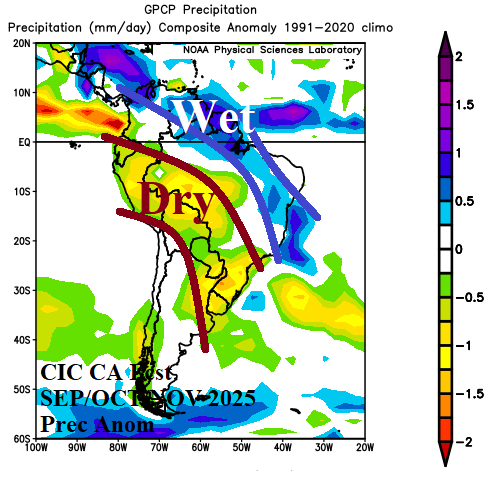
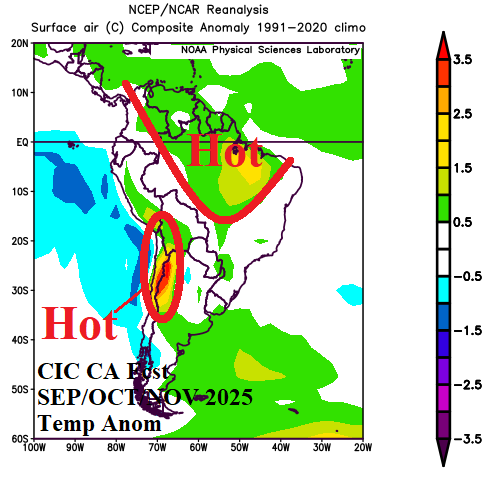
Fig. 3-4: Climate Impact Company constructed analog forecast of temperature and precipitation anomalies for meteorological spring 2025 across South America.
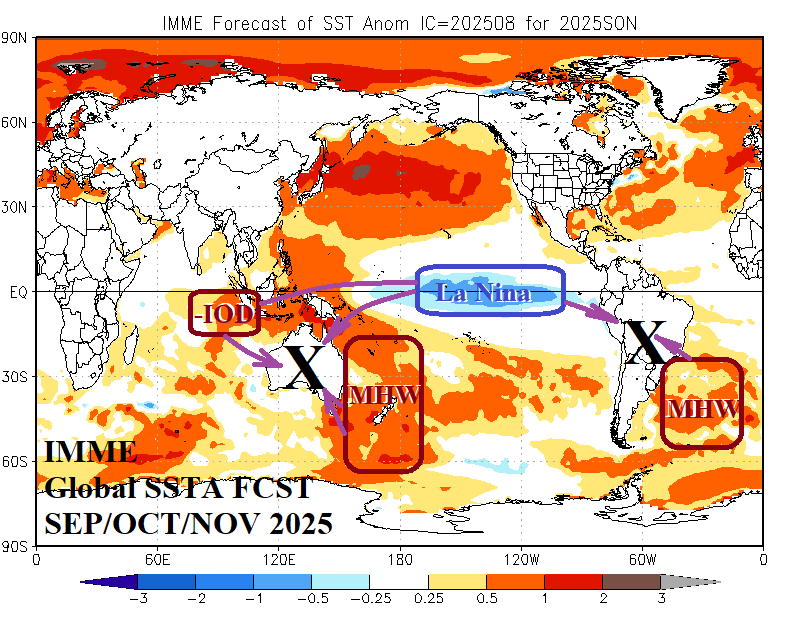
Fig. 5: The International Multimodal Ensemble (IMME) global SSTA forecast valid for SEP/OCT/NOV 2025.
The developing drought area across the Ohio Valley (and eastern U.S. Corn Belt) stays dry in the latest 15-day forecast according to ECM ENS (Fig. 6). In Europe, wet weather continues across U.K. to Central Europe and northward while Southeast Europe to Western Russia is dry (Fig. 7). The eastern Black Sea region is showery.
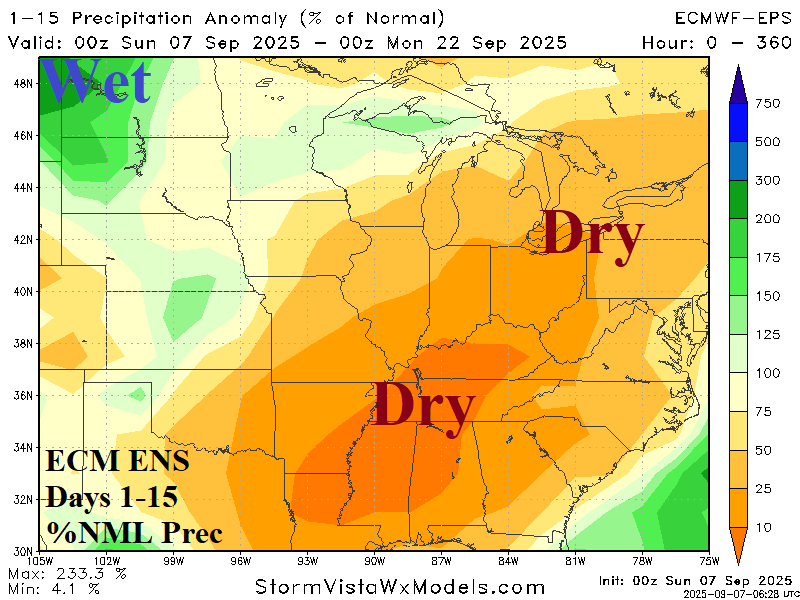
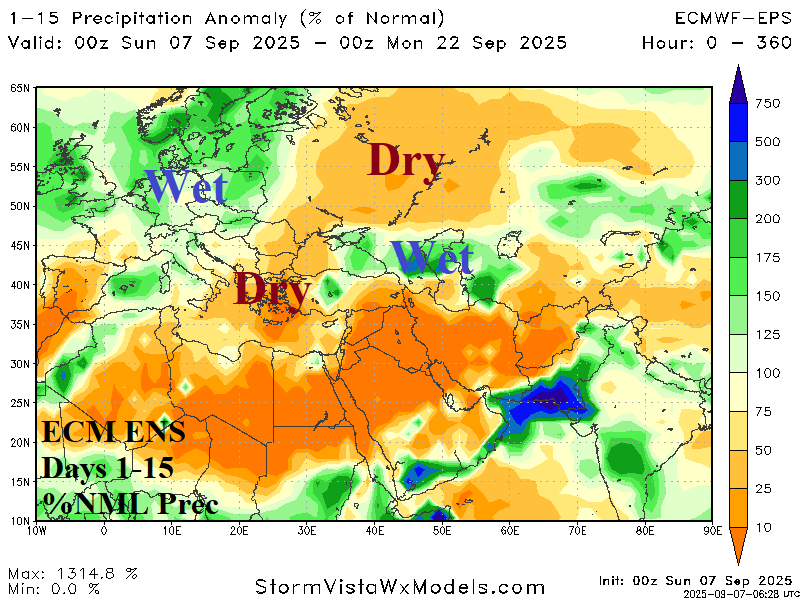
Fig. 6-7: The ECM ENS 15-day percent of normal rainfall forecast for the U.S. AG Belt and Europe/Western Russia.