
U.S. Winter Storm Update: Over to Mostly Ice Interior Mid-Atlantic Today; 1-2 Feet of Snow New York/New England
01/25/2026, 6:17 am EST
-AO Sustains Northern Europe Cold and Energetic Southern Europe Storm Track
01/28/2026, 9:07 am EST
Climate Impact Company ENSO Climate Diagnostics
Issued: Monday January 26, 2026
Highlight: Oceanic La Nina ends.
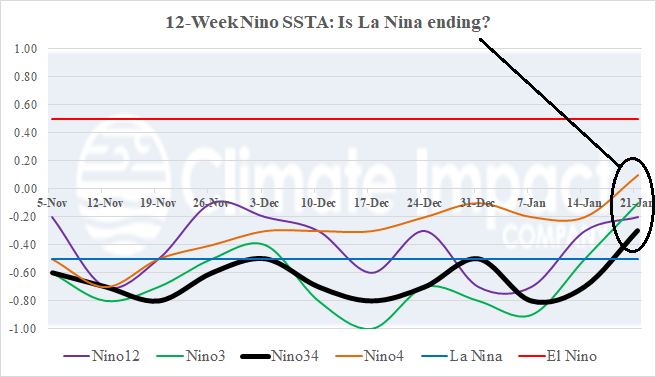
Fig. 1: The 12-week Nino SSTA tracker indicates all Nino regions have warmed to neutral phase as oceanic La Nina ends.
Discussion: During past 4-5 days, the southern oscillation index (SOI) has shifted sharply to negative phase. Causal is an eastward shift across the equatorial East Pacific Ocean of the convection phase of the Madden Julian oscillation (MJO). The MJO was the catalyst to the aerial coverage and intensity of the January 24-25 weekend storm. The event also caused the East Pacific equatorial region to warm. Effective this week, oceanic La Nina has ended as all Nino SSTA regions have shifted to neutral phase (Fig. 1). Any returning cooler SSTA is unlikely due to the steady warming of the subsurface equatorial East Pacific (Fig. 2). The El Nino risk in 2026 is increasing! ECMWF and Australia Bureau of Meteorology are each aggressively forecasting El Nino onset during Q2/2026 (Fig. 3-4).

Fig. 2: The equatorial Pacific Ocean upper ocean heat anomalies.
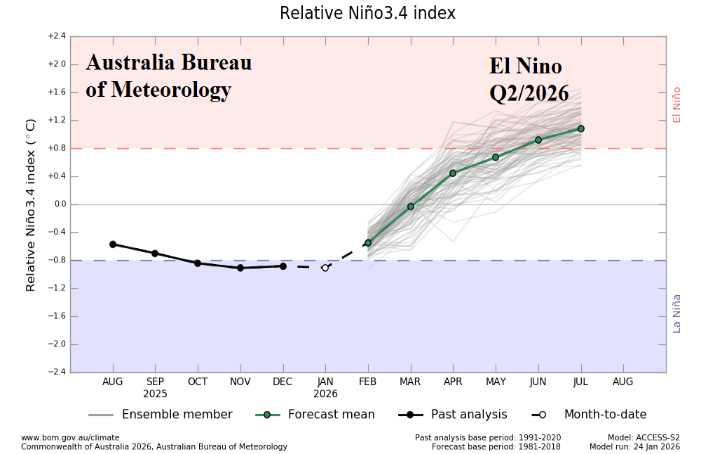
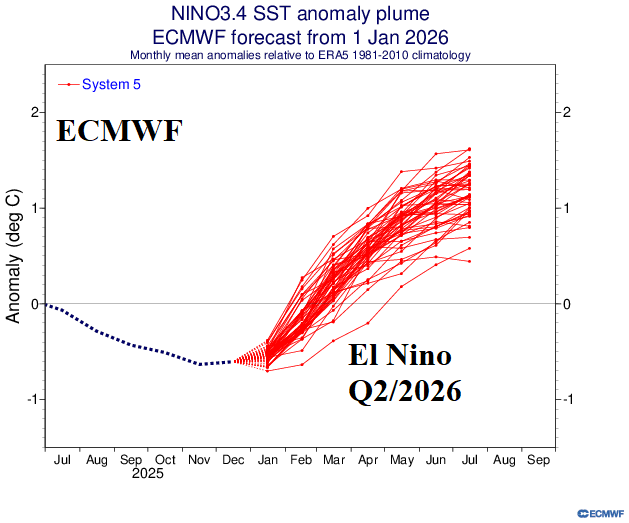
Fig. 3-4: Australia Bureau of Meteorology and ECMWF Nino34 SSTA forecasts each indicate El Nino formation during Q2/2026.