
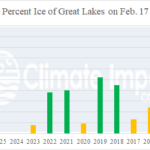
Aerial Coverage of Great Lakes Ice and FEB/MAR/APR Temperature
02/18/2026, 8:47 am EST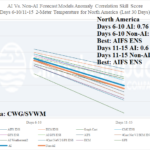
AI Models SLIGHTLY Better Than NON-AI Models Past 30 Days NA and EU
02/26/2026, 8:07 am EST
February 2026 Climate Impact Company Marine Heat Waves Outlook
Issued: Saturday February 21, 2026
Highlight: Helped by anticipated El Nino, marine heatwave aerial coverage increases from 23% now to 37% by late 2026.
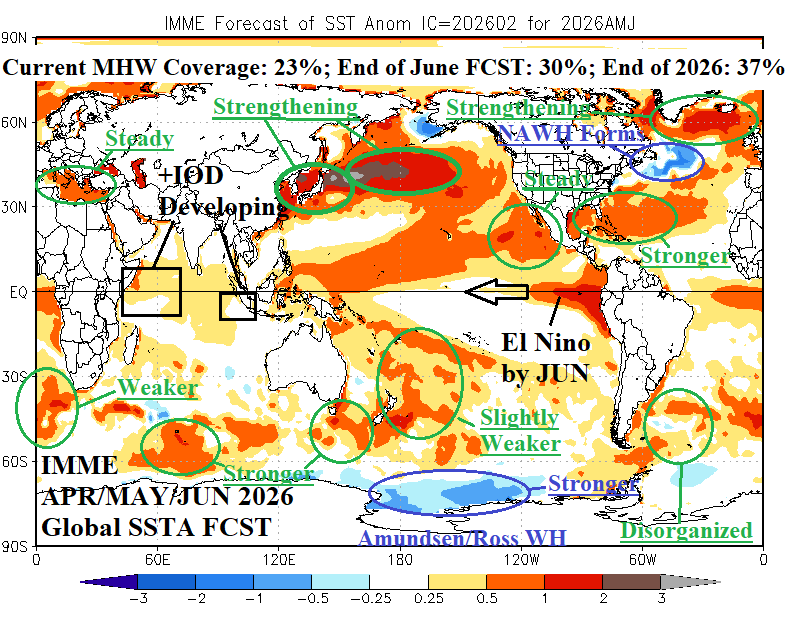
Fig. 1: The International Multi-Model Ensemble (IMME) global SSTA forecast valid for APR/MAY/JUN 2026 with annotations of marine heatwave and cool pool locations and their intensity change.
Discussion: Combining NOAA and Climate Impact Company (CIC) identification of current global sea surface temperature anomalies (SSTA) and the International Multi-Model Ensemble (IMME) SSTA forecast for APR/MAY/JUN 2026 renders expansion of marine heatwave (MHW) risk for 2026. According to NOAA, aerial coverage of global MHW’s is 23% in FEB-26 and forecast to increase to 30% by mid-year and 37% by end of 2026. El Nino development will, in part add to the global oceanic warming in 2026. Despite the warming, two notable cooler trends into mid-year are forecast including the North Atlantic warm hole (NAWH) south of Greenland and an expansive Amundsen Sea WH westward to the Ross Sea. The catalyst to warm holes is freshwater runoff from rapid ice-melt from polar land masses (Greenland and Antarctica). Large MHW’s and WH’s are significant contributors to regional climate and must be considered, along with ENSO, to generate climate forecasts (or explain previous climate observations).
CIC identifies MHW’s outside of the tropics (NOAA includes the tropics). Likely the largest influence on climate in the northern hemisphere as mid-2026 approaches is the semi-permanent (since 2018) expansion of the Kuroshio MHW east of Asia running northeastward past the Dateline. Strong MHW’s during the warm season are often well-correlated to stronger than normal high pressure ridging in the middle troposphere which increases risk of anomalous heat and drought affecting nearby land masses. Similarly, MHW’s off Baja California and strengthening in the Gulf of Mexico and eastward could elevate subtropical ridge intensity affecting Mexico and possibly the Southern U.S. during warm season.
A plethora of MHW’s located in the southern hemisphere will have tendency to weaken or become less organized as the winter climate arrives. Exceptions are MHW’s southeast of Australia and in the Southern Indian Ocean (according to the IMME forecast). In the mid-troposphere, large low-pressure troughs have tendency to form across or downwind WH’s. Significant upper troughing is possible given the size of the Amundsen/Ross WH which increases risk of chilly air masses emitted into South America during the winter season.