News
09/12/2025, 8:42 am EDT

Has the Pacific Decadal Oscillation Flipped to Positive Phase?

Merging between marine heatwave (MHW) NEP25A and NEP25B occurred during late AUG/early SEP as exceptionally warm sea surface temperature anomalies (SSTA) reached the West Coast of North America in the Northeast Pacific. The warming water surface episode is similar with the previously strongest warming event observed during 2013-16, commonly referred to as the “warm blob”.
09/09/2025, 12:22 pm EDT
A map of the united states AI-generated content may be incorrect.

U.S. Meteorological Summer and August (2025) State Climate Rankings

August 2025 brought a cool surprise to the East U.S. including the 7th coolest in the 131-year record for South Carolina. Meanwhile the West, Southwest, and far South U.S. were MUCH ABOVE normal during August 2025. The dryness in the Missouri Valley to New England was profound featuring record dry for Kentucky, Ohio, and Vermont. Georgia was excessive wet during August. The Arizona heat observed in August was the second hottest on record.
09/09/2025, 4:57 am EDT
A map of the world with numbers and a map of the world AI-generated content may be incorrect.

Long Duration Dryness Ohio Valley to Southeast U.S. Closes Calendar Summer

Late calendar summer dryness is excessive across the East/South U.S. as GFS indicates 360 consecutive hours of no rain from Central Texas to Western Pennsylvania and into the Southeast U.S. Consequently, drought development during late meteorological summer in the Ohio Valley is likely to expand southward.
09/07/2025, 12:04 pm EDT
A map of the weather AI-generated content may be incorrect.

South America and Australia Spring 2025 Outlook Review

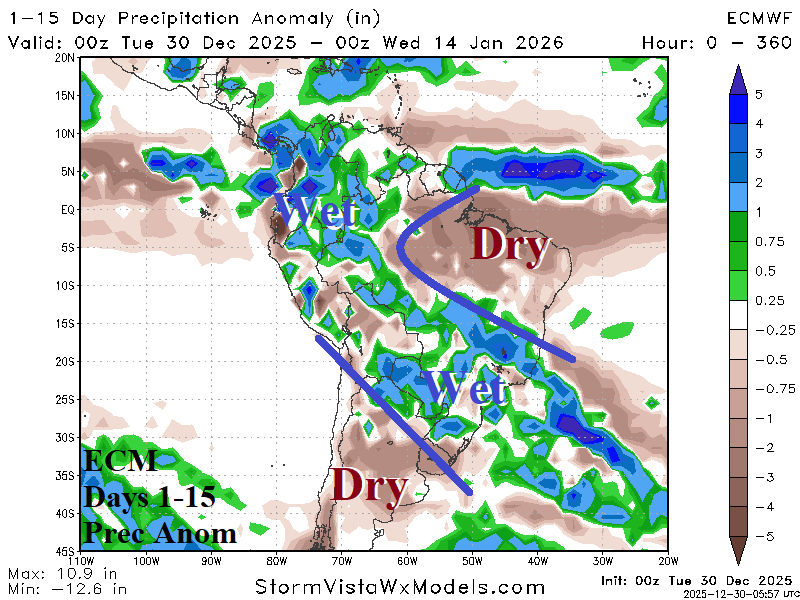
In South America, a drier than normal projection is indicated with average confidence stretching from Peru to Bolivia to Northeast Argentina and Southeast Brazil. A wet regime is likely across northern continent to Northeast Brazil. Anomalous heat builds across northern continent to Central Brazil and across North Chile. The outlooks are based on an analog whereas La Nina and negative Indian Ocean dipole (-IOD) are present during spring coupled with large marine heat waves east of Argentina and east of Australia and New Zealand.