
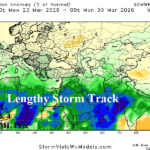
Extended-range Forecast: Evolving Elongated Southern Europe to Middle East Storm Track
03/02/2026, 1:31 pm EST
Climate Impact Company Gas/Power Report
Highlight: Coldest (Norfolk, VA) and warmest (Phoenix, AZ) HDD observations for U.S. meteorological winter 2025-26.
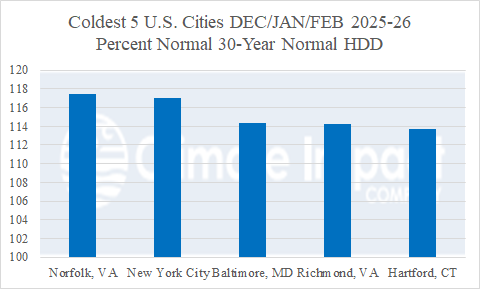
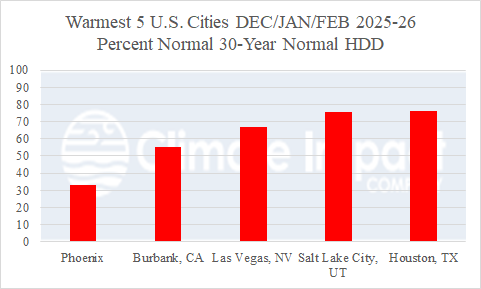
Fig. 1-2: From the Climate Impact Company selected cities list for HDD forecasts, the coldest and warmest 5 cities are identified.
Discussion: Reviewing the Climate Impact Company U.S. heating degree day (HDD) count for selected cities reveals the coldest location for meteorological winter 2025-26 was Norfolk, VA where 117.4% of the 30-year normal HDD was observed (Fig. 1). Values above 110% are considered MUCH BELOW normal temperature (or MUCH HIGHER than normal heating demand). Norfolk was followed closely behind by New York City (117.0%), Baltimore, MD (114.3%), Richmond, VA (114.2%) and Hartford, CT (113.7%). Other MUCH HIGHER than normal (>110% of 30-year normal) heating demand locations included Cleveland, OH (112.8%), Philadelphia, PA (112.1%), Charleston, SC (112%), and Pittsburgh, PA (11.8%).
The warmest locations for meteorological winter 2025-26 (Fig. 2) were Phoenix (33.3%), Burbank, CA (55.0%), Las Vegas, NV (67.1%), Salt Lake City (75.6%), and Houston, TX 76.2%). Values less than 90% of the 30-year normal are considered MUCH WARMER than normal or MUCH BELOW normal heating demand. Rounding out the top ten were Denver, CO (77.4%), Dallas, TX (79.1%), Portland, OR (89.1%), Seattle, WA (90.2%), and Kansas City, MO (90.8%).
The Climate Impact Company selected cities averaged 97.8% of the 30-year normal HDD for meteorological winter 2025-26 compared to 99% last winter.
.