

Slowly, Equatorial Pacific Subsurface Cools
09/02/2025, 9:28 am EDT
AG Market Hot Spot: South America Update
09/04/2025, 5:08 am EDT
Climate Impact Company Daily Feature
Issued: Wednesday, September 3, 2025
Highlight: NOAA updates wildland fire forecast for SEP/OCT. Rare New England risk, widespread California risk, and all of Hawaii at risk.
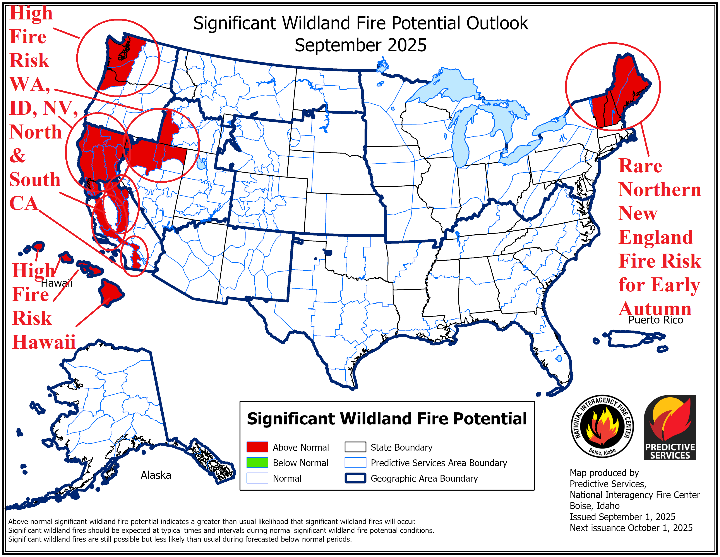

Fig. 1-2: NOAA significant wildland fire potential outlook for September and October.
Discussion: NOAA reissues their significant wildland fire potential outlook for September and October. Not surprising is the rapid risk increase for many parts of Central and Southern California plus all Northern California (Fig. 1). The above average risk extends to Northern Nevada and Southwest Idaho. Added is the western portion of Washington. Wildland fire potential risk is above average near many major city and town locations for Western Washington and California.
A rare above normal risk of wildland fires is indicated for northern New England in September where late season drought has accelerated. Also, the entire state of Hawaii is at risk of wildland fires during September and October (Fig. 2).
In October, the wildland fire risk remains above average for the San Francisco Bay area and northward and shifts westward to the coastal region of Southern California. The Southern Appalachian Mountains are added to the wildland fire risk for October.
The strongest marine heat waves (MHW) on record in the West Pacific and in-between Japan and the Asia Coast extending to MHW’s NEP25A and NEP25B in the Northeast Pacific (Fig. 1) are well-correlated to the summer 2025 upper air pattern featuring a strong upper-level high-pressure ridge (Fig. 2). Similarly, the MHW’s in the east/northeast portion of the North Atlantic are well-correlated to a semi-permanent upper-level high-pressure ridge dominating the west/south portion of Europe during summer 2025. Equally impressive is the compensating upper trough centered on Greenland and westward during summer 2025 near and just north of the North Atlantic Warm Hole (NAWH). The prevailing pattern is forecast to change in September, likely due to seasonality and a possible significant uptick in tropical cyclone activity.
The 1-15-day northern hemisphere 500 MB anomaly forecast by the high-skill AIFS ENS indicates the NAWH low pressure system shifts northward toward the North Pole (Fig. 3). The northward shift allows a subtropical ridge to strengthen northeast of the Bahamas suggesting the recently cooling waters due to Erin will rewarm. The increasing westerlies south of the North Pole trough push the Europe ridge farther inland. The MHW-induced high pressure area east of Asia persists.
In the extended-range, days 16-30, AIFS V2 4CastNet V2 ECM ENS and ECM are similar with upper air features (although AI is stronger) projecting northern latitude high pressure ridge areas over Canada, Northern Europe, and near the Aleutian Islands while pressure lowers in the subtropics (Fig. 4-5). Northeast Asia cools while the subtropical ridge over locates over China.
Summary: The September 2025 northern hemisphere pattern changes. Northern latitude anomalous warmth beneath high pressure increases and lowering pressure in the subtropics fuels a significant uptick in tropical cyclone activity.

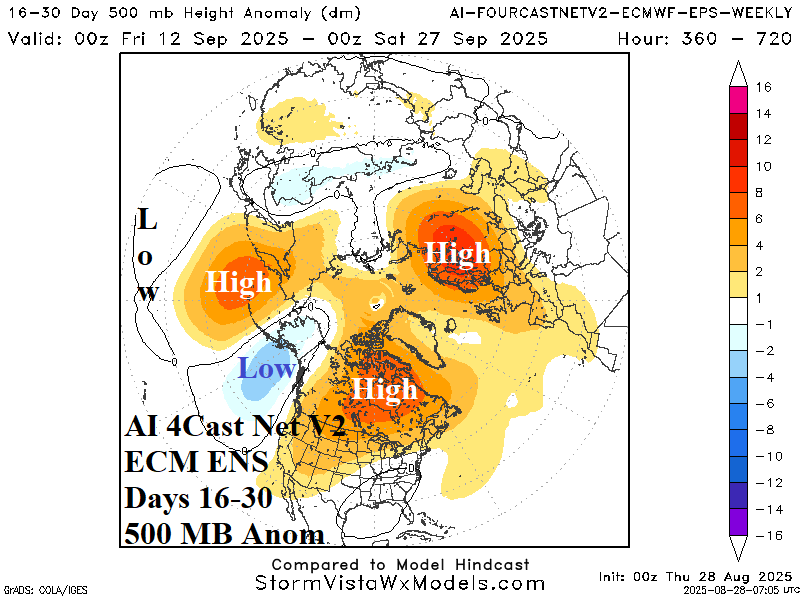
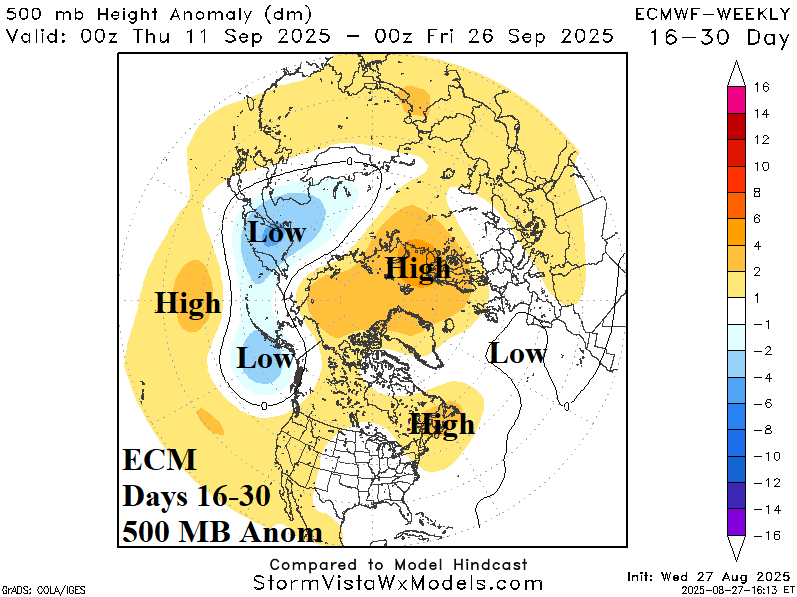
Fig. 3-5: The AIFS ENS 1-15-day northern hemisphere 500 MB anomaly pattern and a comparison for days 16-30 between AI 4CastNet V2 ECM ENS and ECM.