
Busy Period Ahead: Wides Swings in U.S. HDD Forecasts!
12/31/2025, 8:29 am EST
Colder HDD Forecast for Europe January 2026
01/05/2026, 4:24 am EST
Climate Impact Company Daily Feature
Issued: Friday, January 2, 2026
Early January leading climate diagnostics: Highly variable stratosphere, an eastward charging Kelvin Wave, and strengthening marine heatwaves.
Discussion: The evolving stratospheric temperature anomaly pattern during the first half of January is warming across Eurasia and cold in North America, the direct opposite regime of early meteorological winter (Fig. 1). Beneath the high variation in stratospheric temperature, the troposphere (below) responds by warming North America while very cold air is ongoing in Europe and develops in Siberia (Fig. 2). So far, northern hemisphere winter has produced both warm and cold temperature extremes regulated primarily by a busy stratosphere influence. Meanwhile, the December upper ocean heat anomalies across the equatorial Pacific warmed to near or slightly above normal including east of the Dateline (Fig. 3). Cool fuel to sustain La Nina is steadily weakening. A Kelvin Wave extends across the Dateline with increasing intensity reaching 130W (Fig. 4). Further eastward expansion of the Kelvin Wave will end the short duration La Nina event in the next few weeks. Marine heatwaves (MHW) are strengthening off the North America and South America West Coast (Fig. 5). Further equatorial expansion may signal an ENSO phase change toward El Nino in a few months.
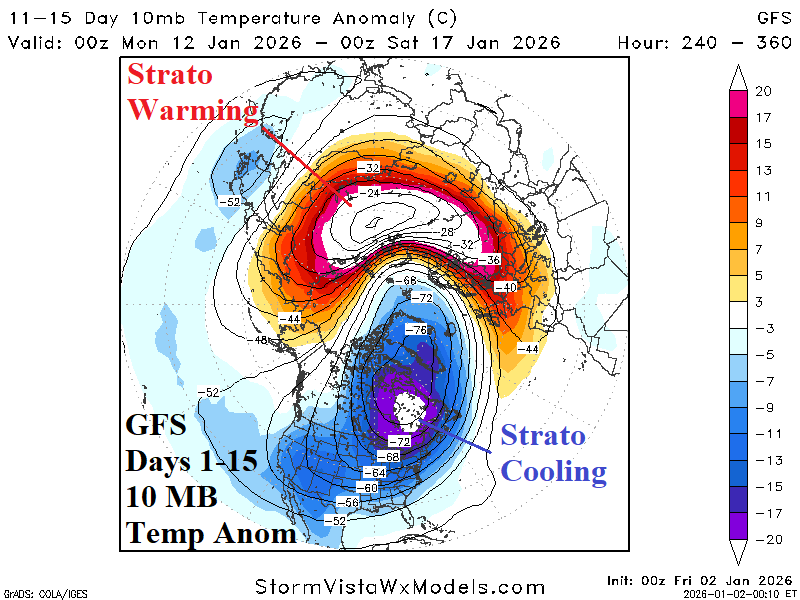
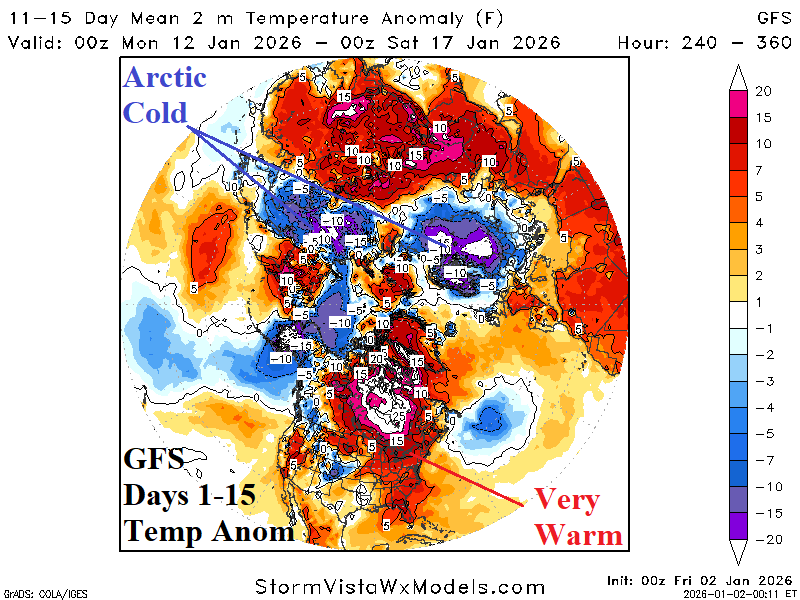
Fig. 1-2: The GFS 15-day 10 MB temperature anomaly forecast and responding surface temperature outlook.
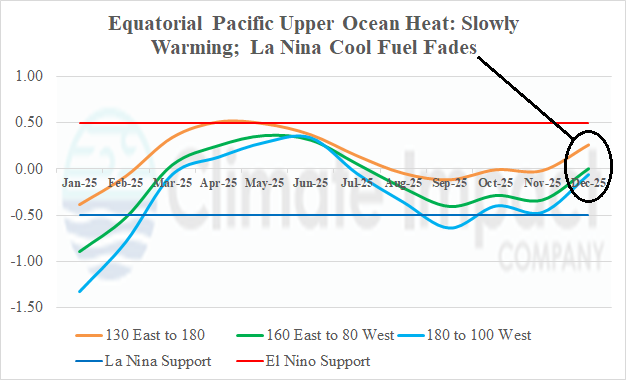
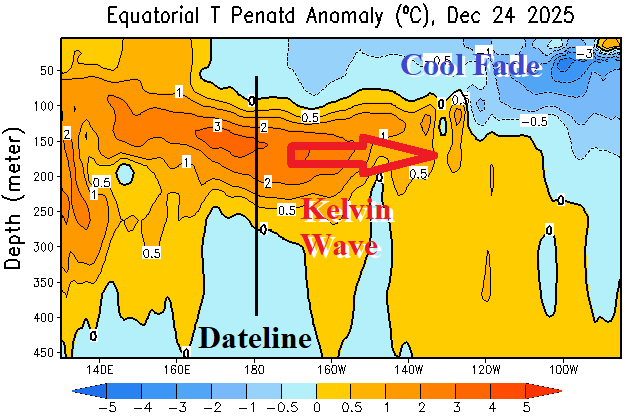
Fig. 3-4: The 12-month equatorial Pacific Ocean subsurface upper ocean heat tracker and identification of a Kelvin Wave moving past the Dateline.
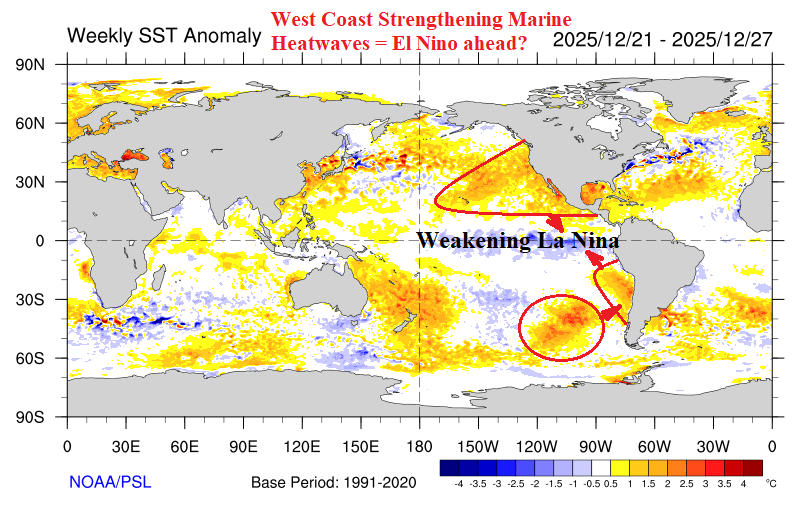
Fig. 5: The global SSTA analysis for the week of Dec. 21-27, 2025.