
-PNA/+NAO Influences on U.S. Climate
03/09/2026, 5:27 am EDT
Climate Impact Company Climate Research
Issued: Friday, March 13, 2026
Highlight: Are marine heatwaves correlated to the upper air pattern causing sensible weather?
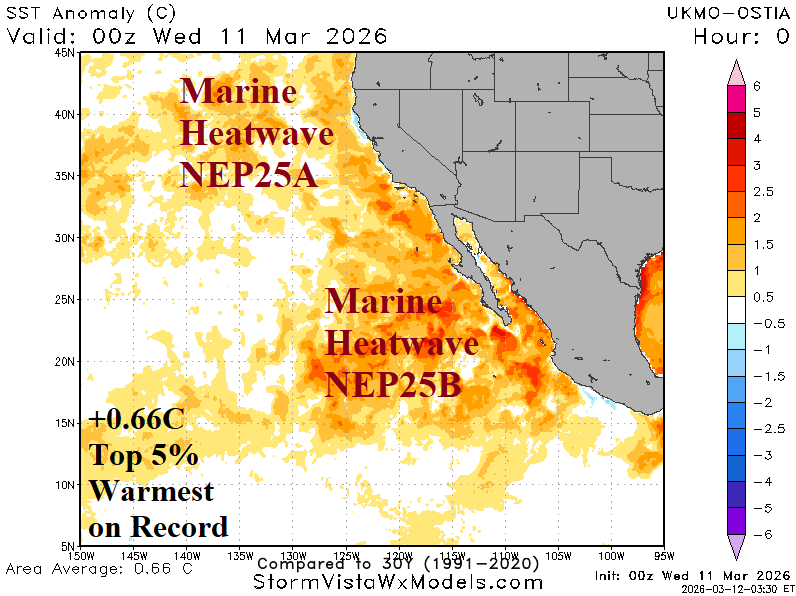
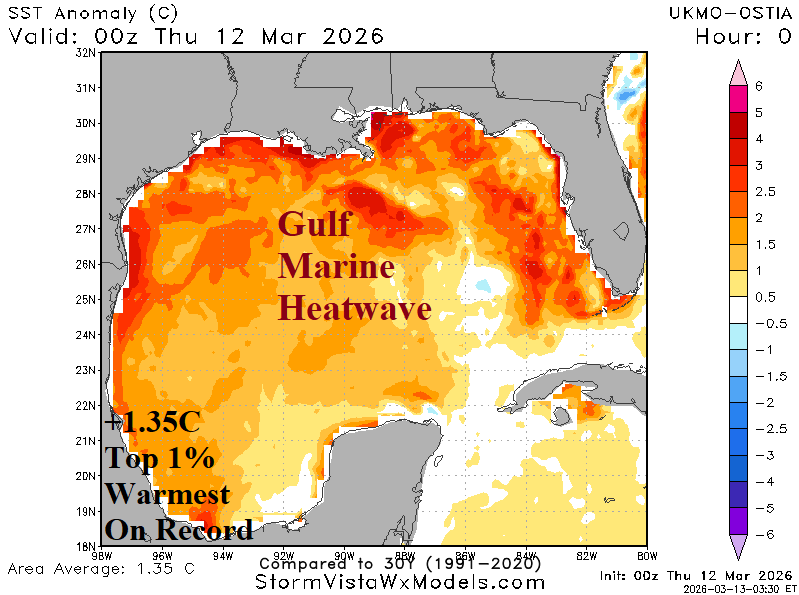
Fig. 1-2: Daily SSTA analysis of the southeastern North Pacific and Gulf of Mexico basins identifying buoyant marine heatwaves.
Discussion: Two marine heatwaves (MHW) are located off the U.S. and Baja California West Coast (Fig. 1). MHW NEP25A reached record aerial coverage last autumn although weaker now while MHW NEP25B formed late last year, persisted all winter, and strengthened. Meanwhile, the Gulf of Mexico SSTA is +1.35C (Fig. 2) ranking in the top 1% warmest (since 1982). The warming is due to an immense MHW which continues to strengthen. Large MHW’s are frequently well-correlated to 500 MB high pressure ridge patterns as identified by the 100-day North America 500 MB anomaly analysis (Fig. 3). Beneath the upper ridge, most of the West/Southwest U.S. observed a record warm winter season. Note how the upper ridge shapes the downstream upper air pattern which featured periods of arctic cold into the East U.S. during the winter season. The MHW influence on North America climate continues into early spring. The AIFS ENS 15-day 500 MB anomaly forecast projects the broad upper ridge continuing across the Southwest U.S. (Fig. 4) with peak strength in the 6-10-day period. Maximum daily temperature records are likely, with 105F projected for late next week in Phoenix, AZ (Fig. 5) and near 80F as far north as Boise, ID (Fig. 6). Similar with winter 2025-26, the upper ridge pattern helps to tilt the upper air flow out of the northwest from Canada to deliver cold air outbreaks to the Midwest States TUE/WED next week and the Northeast U.S. the following weekend.
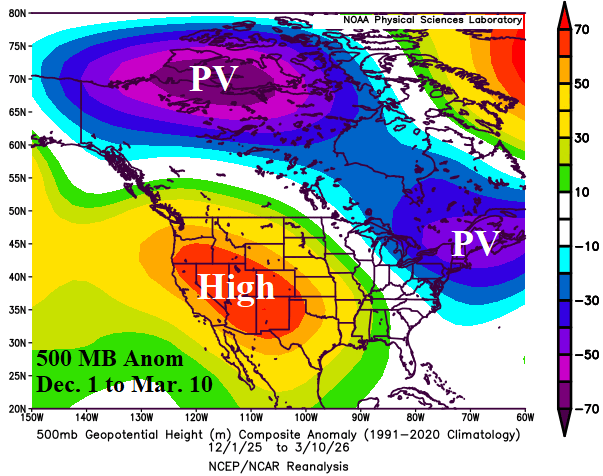
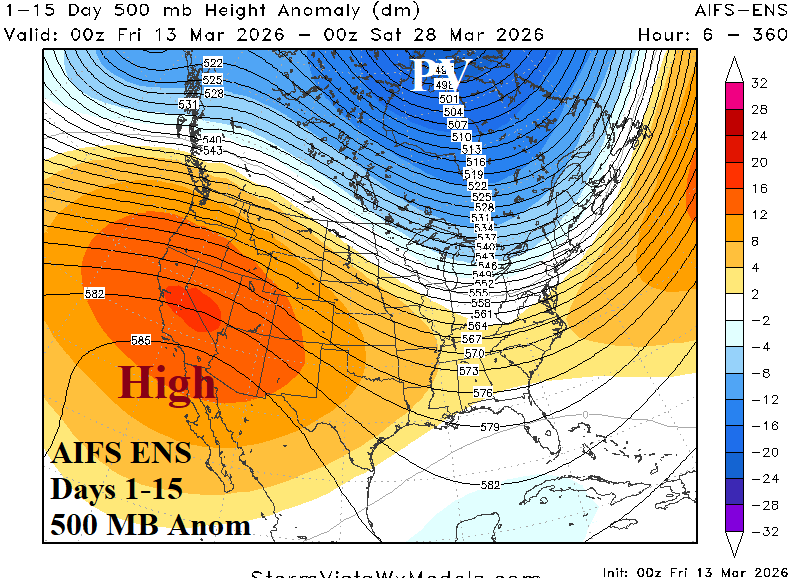
Fig. 3-4: Since Dec. 1, 2025, the North America 500 MB anomaly pattern and the AIFS ENS 15-day 500 MB anomaly forecast.
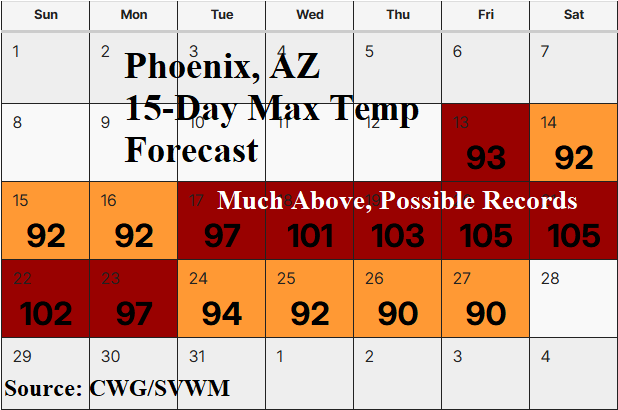
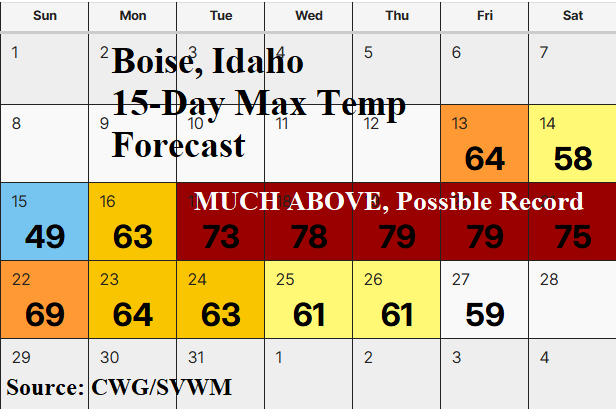
Fig. 5-6: The 15-day maximum temperature forecast for Phoenix, AZ and Boise, ID indicating potential record warmth.