
ECM Maintains Wet Bias to Brazil Forecasts
10/26/2025, 12:10 pm EDT
Current Short-term and Winter U.S. (and Europe) HDD Projections
10/29/2025, 6:01 am EDT
Climate Impact Company Climate Research
Issued: Monday October 27, 2025
The quasi-biennial oscillation has entered the easterly phase raising the risk of sudden stratospheric warming events that cause “polar vortex” regimes during winter. A review of that assertion.
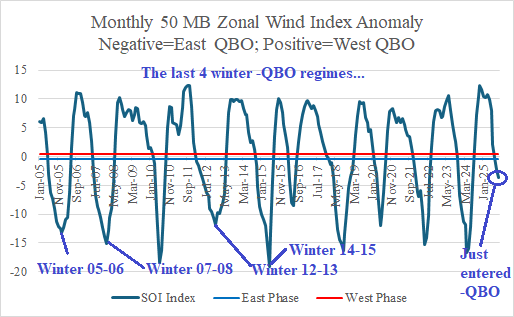
Fig. 1: The monthly QBO index at 50 MB from 2005 to current identifying the last moderate-to-strong negative (easterly) phase which occurred during winter.
Discussion: Recent research regarding “Sensitivity of Easterly QBO’s Boreal Winter Teleconnections and Surface Impacts to SSWs” by Dillon Elsbury, Amy Butler, Yannick Peings, and Gudrun Magnusdottir was reviewed to assess the claim that wintertime SSWs are more common during the easterly phase of QBO.
The question is important due to the direct connection of sudden stratospheric warming (SSW) events causing a split in the polar vortex with southward migration to Eurasia and North America causing arctic air generation and outbreaks for high population middle latitude locations.
The quasi-biennial oscillation (QBO) is an upper atmosphere tropical phenomenon whereas east and west phase shift predictably every (on average) 28 months. The QBO has an influence on polar vortex strength and therefore the mid-latitude jet stream strength which can influence high impact temperature and storminess regimes during the winter season.
Currently, the QBO is entering the (negative) easterly phase. The east phase (EQBO) is likely to strengthen significantly over the next 3-6 months.
This subject arises due to the general assertion that SSWs are more common during EQBO regimes. Consequently, winter of 2025-26 is susceptible to SSW events, risk of “polar vortex” events and their attendant cold and snow production to high population locations in the middle latitudes. The research tries to prove the relationship.
The result of the study indicates consistent correlation of EQBO to SSW events is difficult to produce with models. However, the authors recognize that their processes are not completely recognizing all forces (which are considerable) in this interaction. Confirmed is the previously well-understood relationship the emergence of strong tropical Rossby Waves emitting heat into the upper atmosphere which travels poleward to warm the stratosphere. These events are likely associated with the convection phase of the Madden Julian oscillation (MJO). The study concludes that additional study between the MJO and SSW events (plus the North Atlantic oscillation) is needed.
The study also identified warming of the Southern Asia continent during late winter can cause SSW events (likely similar with the Rossby Wave poleward shift from the tropics).
The strongest EQBO from recent winter seasons include 2005-06, 2007-08, 2012-13, and 2014-15. The stronger EQBO seems independent of ENSO phase. During winter 2005-06, SSW events took place over Asia in DEC, the polar region during JAN, and reversed cold in FEB. A classic SSW episode emerged gradually during mid-to-late winter 2007-08. A brief SSW took place during winter 2012-13 in JAN. Finally, winter 2014-15 brought a weaker and transitory SSW event during JAN/FEB. The last significant wintertime SSW occurred during JAN-24.
In conclusion, traders/risk analysts should be alerted to the general relationship between EQBO and increased risk of SSW events. Climate Impact Company asserts that the traditional understanding of SSW events caused by Rossby Waves emitted poleward into the upper atmosphere from the tropics caused by a strong convection phase of the MJO be the number one diagnostic to monitor to predict a possible SSW. Reasonable is the prediction of SSW episodes 2-3 weeks in advance.