
Equatorial Pacific Ocean Subsurface Heat Warming; La Nina Likely to End Early 2026
12/29/2025, 11:54 am EST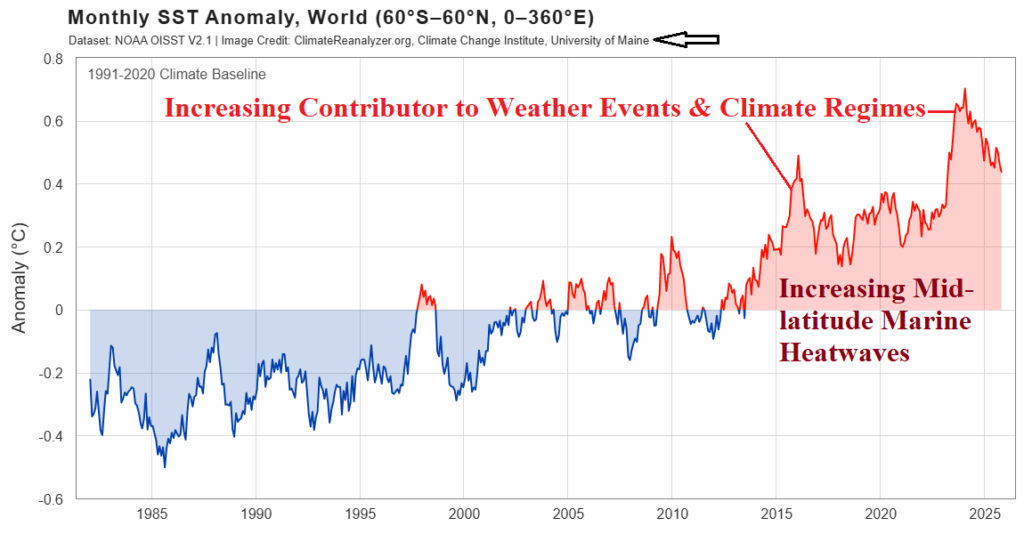
The Warming Oceans Increasingly Contributing to High Impact Weather/Climate
The warming oceans are an increasing contributor to high impact weather events and climate regimes.
Weather and climate are (generally) one of the leaders in driving volatility, and therefore opportunity, in commodities markets. However, 2025 market volatility driven mostly by changeable tariff and trade policies forced weather and climate farther back. Another increasingly hot topic in 2025 within the commodity markets is the rapidly increasing influence of artificial intelligence impacts.
Globally, 2025 projects as the third warmest on record (DEC-25 data not yet available as of this writing). As of December 1st, the U.S. has observed the fifth warmest year in the 131-year period of record. A significant contributor to the warmer climate is the influence of increasing ocean temperature, most notable in the middle latitudes accelerated by the presence of marine heatwaves (MHW).
The El Nino southern oscillation (ENSO) shifted from a moderate strength El Nino early in the year to a weak La Nina during late 2025. The historical impacts of ENSO on global climate have shifted, at times, due to the influence of MHW’s. Consequently, the reliance on ENSO to project future seasonal climate has lost partial skill. New forecast processes to solve this issue, including the use of AI, are of intense research nowadays.
Selected warmer ocean/climate change-oriented high impact weather events from each month of the past year include:
January: Lucky time of year to visit Hawaii where the warmest January on record occurred. Culprit: Large MHW surrounding the island.
February: Extreme rain caused severe flooding, loss of life, and massive infrastructure damage in parts of Italy, Botswana, and Queensland. Culprit: Unusually warm ocean temperatures across the Mediterranean Sea, south of Africa, and surrounding Australia.
March: Europe and Australia observed their warmest March on record. Culprit: Warmer than normal ocean temperatures warm the mid-atmosphere and cause dry/warm high-pressure patterns.
April: Early summer-like heat in India (115.5F) and Pakistan (120F). Culprit: Unusually intense subtropical high-pressure; Scientists have warned that this region may be the first in the climate change era to observe unsurvivable heat given the persistence of this feature.
May: For the 3-month period ending in May, the global landmass experienced the warmest 90-day temperature on record. Culprit: Extremely warm meteorological spring across North America and Eurasia.
June: Earliest major hurricane on record (Erick) to strike the South Coast of Mexico. Culprit: Abundant upper ocean heat.
July: Warmest July on record in Japan. Culprit: Immense MHW off the East Asia Coast.
August: After searing heat of early summer, severe floods from extreme rain in Pakistan. Culprit: Classic climate change circumstance: Long duration heat/drought interrupted by brief periods of extreme rain (driven by the warmer oceans).
September: Asia 2nd warmest, Europe 4th warmest, and North America 3rd warmest month of September on record. Culprit: Peak annual anomalous warmth of the mid-latitude oceans.
October: Major Hurricane Melissa ties Labor Day 1935 Hurricane as the strongest (wind speed [185 mph] and pressure [892 MB]) land-falling Atlantic hurricane on record. Jamaica was the target. Culprit: Third warmest upper ocean heat on record in the Caribbean.
November: Rare late season tropical cyclones bring catastrophic flooding after extreme rain overwhelms rivers and drainage systems throughout parts of Southeast Asia and Western Indonesia. Culprit: Unusually strong large-scale convective system known as the Madden Julian oscillation (MJO).
December: Surprise record cold across the East U.S. Culprit: A sudden stratospheric warming event across the North America side of the North Pole.