

Onto Solar Cycle 26
09/23/2025, 2:47 pm EDT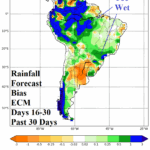
ECM Wet Forecast Bias Days 16-30 Past 30 Days
09/25/2025, 11:01 am EDT
Climate Impact Company Daily Feature
Issued: Wednesday, September 24, 2025
Highlight: Expanding early season snow cover in Russia.

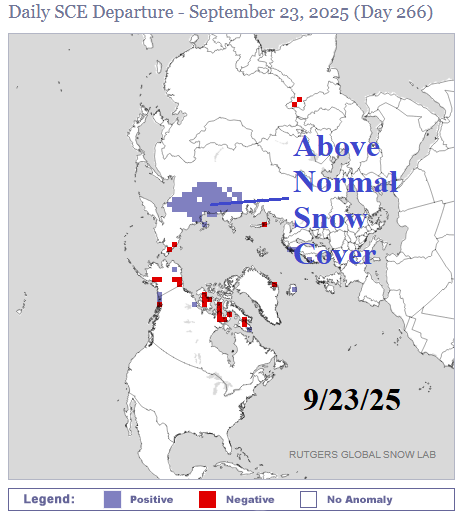

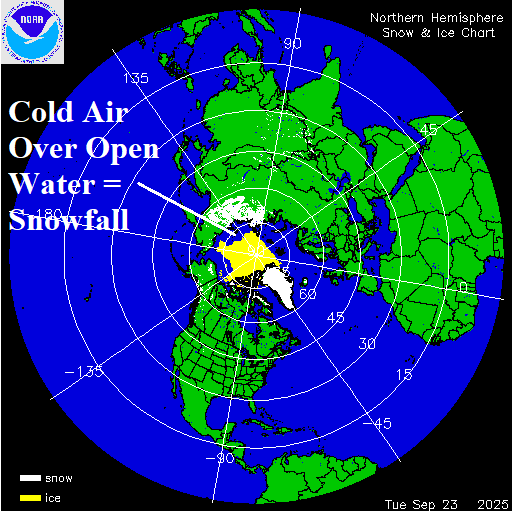
Fig. 1-4: The Rutgers Snow Laboratory daily snow cover and snow cover anomaly analysis plus the GFS 15-day temperature anomaly forecast for Asia and the polar ice cap location.
Discussion: Early season snow cover has developed over North/Northeast Russia (Fig. 1). The snow cover in that region for later September is above normal (Fig. 2). Snow cover expansion is likely. The GFS 15-day temperature anomaly forecast indicates widespread cooler than normal temperatures with snow snowfall across Northern Russia and the attendant cool air mass extending southward (Fig. 3). Although the early season snowfall in this region is above normal, the snow is not unusual. Given the constricted polar ice cap (Fig. 4) and early season colder wind extending across open water, advection snows can occur in far northern latitudes especially Northern Russia in early autumn. Of course, the snow cover biases the region cooler and can influence the prevailing weather pattern across Eurasia which features a partial extension of the cool regime described southwestward beneath a longwave trough and into the Black Sea region.