News
10/20/2025, 7:30 pm EDT
A map of the united states AI-generated content may be incorrect.

Week-4 Upper Air Forecasts for North America

The upper air forecast for week-4 is highly variable ranging from an amplified (warm) Central U.S. high pressure ridge according to CFS V2 to a deep cool upper trough centered on New York based on the 4Cast Net V2 ECM ENS, or somewhat of a compromise by ECMWF. MJO projections for mid-November are in phase_6 (near the Dateline) which favors a warm solution for the U.S. ECM is the chosen model with CFS V2 the caveat forecast while leaning away from the cooler East AI scenarios.
10/15/2025, 7:01 am EDT
A graph of the weather AI-generated content may be incorrect.

The Warm Oceans, Causal to Warm Medium-range Forecasts

Day-to-day, medium/extended-range forecasts in North America are usually warmer than normal. A leading catalyst to that regime is much warmer than normal global ocean surface, most apparent in the middle latitudes beneath the prevailing upper-level westerlies that drive out climate. Maine heatwaves have increased dramatically in the middle latitudes particularly in recent years.
10/14/2025, 9:21 am EDT
A graph of different colored lines AI-generated content may be incorrect.

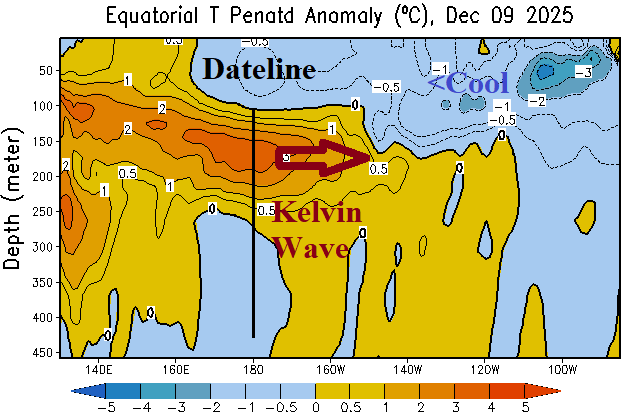
Nino SSTA Neutral Despite Onset of La Nina Announcement by NOAA

Last week, the Nino SSTA regions each warmed slightly and are all in neutral range as mid-October approaches. Despite neutral Nino SSTA, NOAA announced La Nina onset last Thursday. The subsurface equatorial East Pacific is broadly cooler than normal. The trend is slightly cooler from 2 weeks ago.
10/13/2025, 7:11 am EDT
A diagram of a person's face AI-generated content may be incorrect.

Transitional MJO Weakens Strong -GLAAM; Highly Amplified Mid-latitude Pattern to Ease

For the first time since earlier in the year, the convection phase of the Madden Julian oscillation (MJO) is moderately intense AND transitional. Implied is the slow demise of a tendency for a highly amplified trough/ridge pattern in the middle latitudes as supported by the 15-day global atmospheric angular momentum (GLAAM) forecast which maintains the negative index but with less amplitude.