News
10/21/2025, 4:38 pm EDT
A map of a hurricane AI-generated content may be incorrect.

Will Melissa Be an RI Candidate?

Upper shear is inhibiting development. However, once an organized inner core has formed, given the 86F/30C SST which is 1-2C warmer than normal and 3rd warmest upper ocean heat on record for the Caribbean Sea, there is potential for rapid intensification (RI) as early as Thursday (HWRF) or later this week (HMON) to a strong category-2 hurricane or category-3 major hurricane.
10/20/2025, 7:28 pm EDT
A graph with a line and a line AI-generated content may be incorrect.

Can I Use Southern Oscillation Index to Approximate Multivariate ENSO Index?

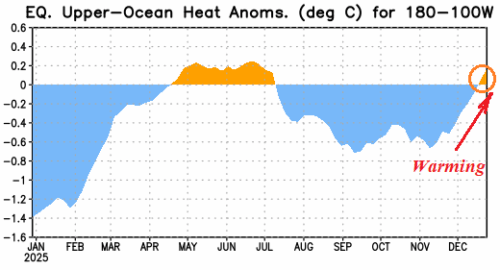
NOAA’s multivariate ENSO index (MEI) changed its data input from the Japanese Meteorological Agency’s JRA-55 reanalysis dataset to JRA-3Q as of January 2024. However, the data has not been attainable since May although NOAA claims the data is available (although hard to decipher with the government shutdown). MEI is a handy climate diagnostic identifying the atmospheric reaction to the SSTA/SLPA pattern across the Pacific tropics/subtropics.
10/16/2025, 8:19 am EDT

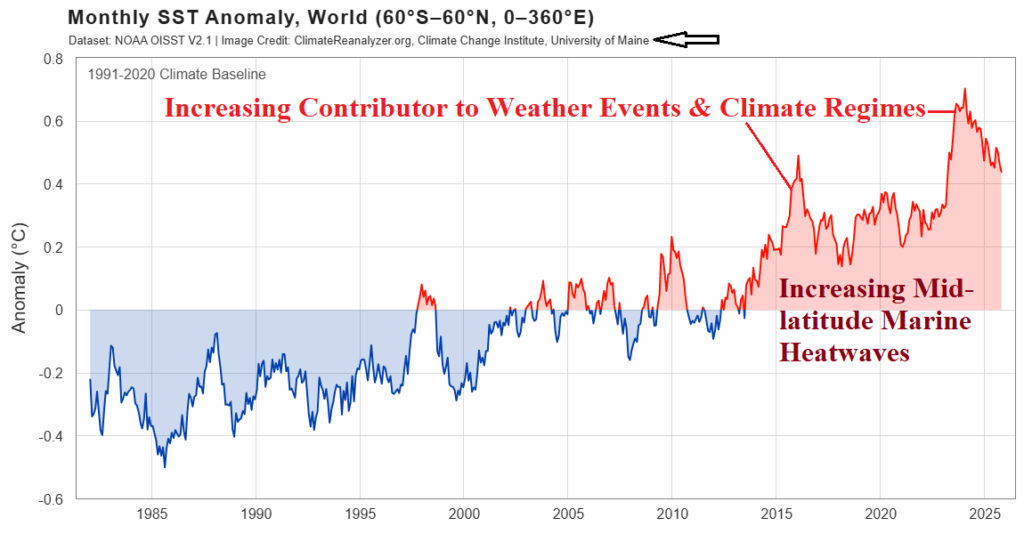
October 2025 Marine Heatwave Outlook

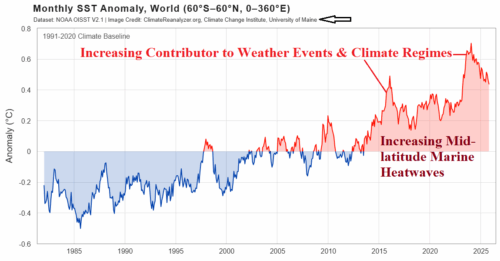
The latest marine heatwave report identifies many large episodes in the northern hemisphere, common during early autumn in the current decadal pattern. Strongest marine heatwaves are off the East Asia Coast, Central Pacific, and off the Northwest Eurasia Coast. The "warm blob" in the Northeast Pacific during late summer has rapidly weakened during the past several weeks. Southern hemisphere marine heatwaves will strengthen as summertime arrives.
10/13/2025, 6:05 am EDT
A map of australia with different colors and numbers AI-generated content may be incorrect.

The Surprising Dry Climate in Australia

In a surprise, the month of September and especially October (so far) have averaged drier than expected considering the normally wet bias Australian climate produces when Indian Ocean dipole (IOD) is negative and La Nina is developing. The dry and increasingly warmer than normal pattern, especially in the East (and more recently across the North) is due to negative phase of the southern annular mode (-SAM) or negative Antarctic oscillation (-AAO) in that anomalous high pressure covers Antarctica forcing strong mid-latitude upper troughs, one of which is south of Southeast Australia.