News
02/21/2026, 1:38 pm EST
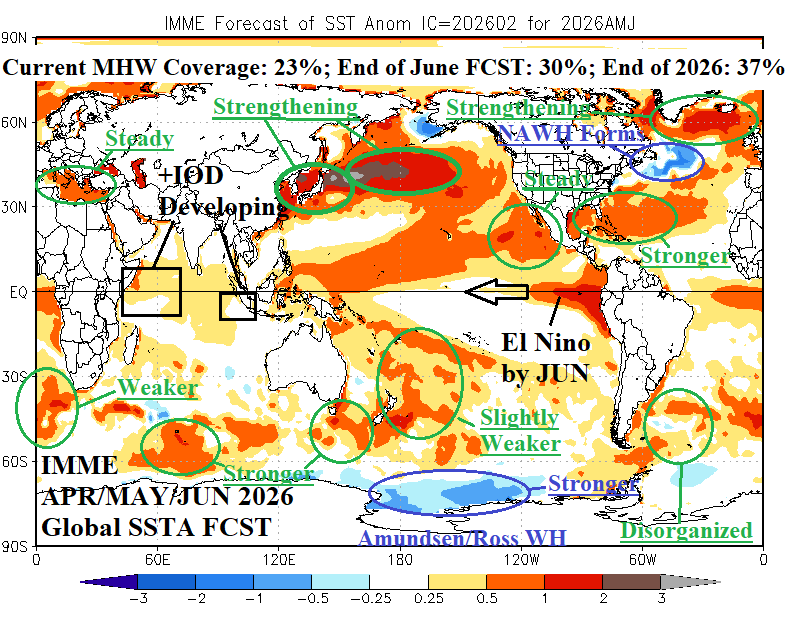
February 2026 Global Marine Heatwaves Outlook: Expect a significant increase in 2026

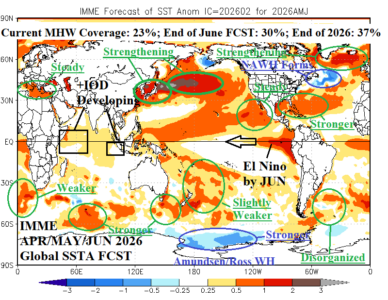
Combining NOAA and Climate Impact Company (CIC) identification of current global sea surface temperature anomalies (SSTA) and the International Multi-Model Ensemble (IMME) SSTA forecast for APR/MAY/JUN 2026 renders expansion of marine heatwave (MHW) risk for 2026. According to NOAA, aerial coverage of global MHW’s is 23% in FEB-26 and forecast to increase to 30% by mid-year and 37% by end of 2026.
02/18/2026, 8:47 am EST

Aerial Coverage of Great Lakes Ice and FEB/MAR/APR Temperature

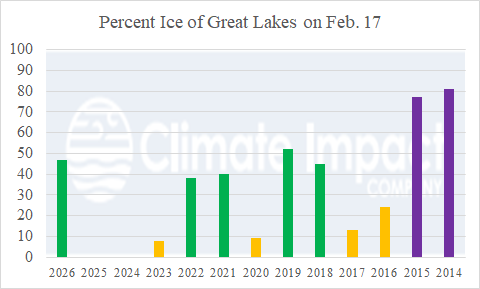
As of February 17th, the aerial coverage of ice across the Great Lakes is 47%. Since 2014, the current aerial coverage of Great Lakes ice is about average. When Great Lakes ice has been above average as observed during the 2013-14/2014-15 polar vortex winter seasons, FEB/MAR/APR climate across North America was biased colder than normal. When ice is at moderate levels similar with 2026, a cold bias during FEB/MAR/APR appears to the west of the Great Lakes region
02/16/2026, 11:52 am EST

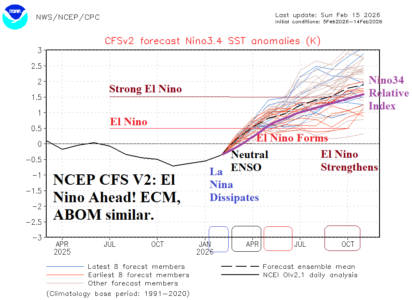
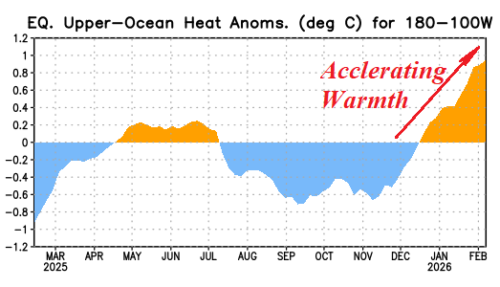
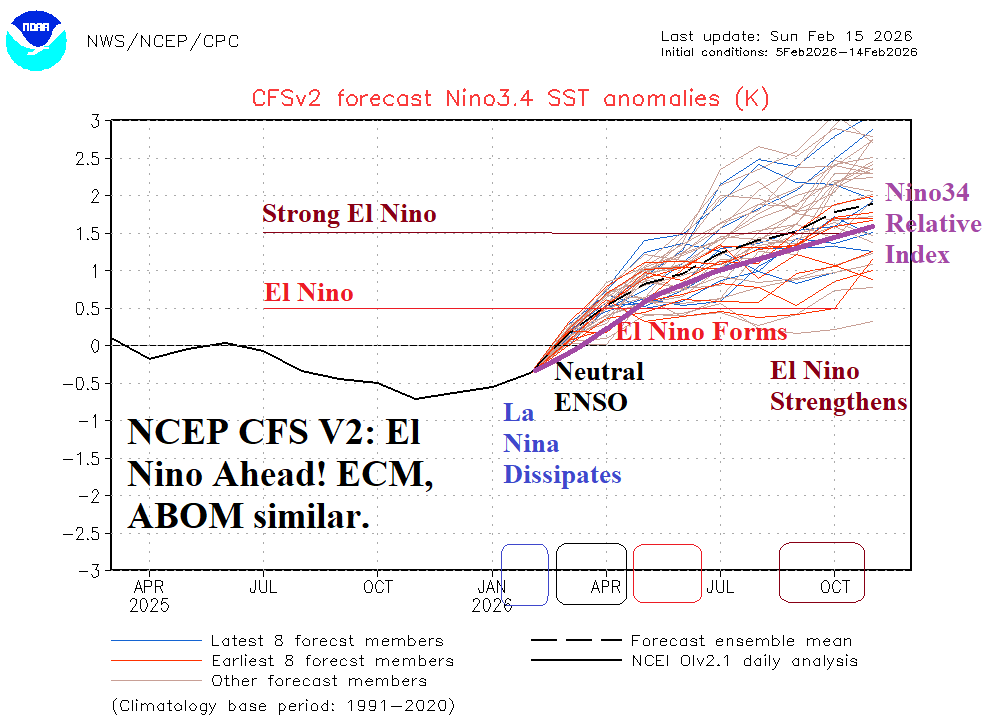
Oceanic La Nina Ends, Subsurface Warming Validates El Nino Forecasts for Mid-year. But! Atmosphere Not Responding Yet.

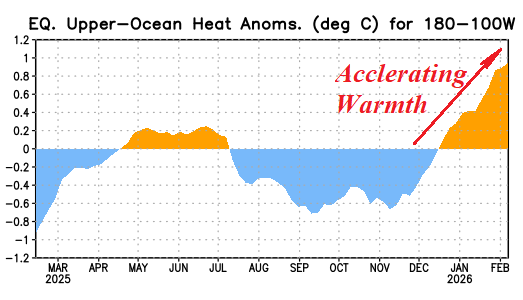
The subsurface eastern equatorial Pacific continues too steadily warm. A Kelvin Wave moving east across the Dateline during early December reached waters off northwest South America recently while a second Kelvin Wave emerged near and east of the Dateline and is drifting eastward. The atmosphere remains slow to respond as southern oscillation index (SOI) stays positive and 15-day forecasts maintain the positive phase.
02/13/2026, 5:55 am EST

Support To Keep U.S. Warm Increasing; Comments on New NOAA RONI Index

GFS indicates a progressive MJO toward the Dateline in the 8-14/11-15-day period. If so, ongoing U.S. warmth continues and could become stronger. Yesterday, NOAA introduced the Relative Operational Nino Index (RONI) which provides a new Nino34 index accounting for the historical general warming of the global tropics. But! Does this new index effectively identify ENSO pattern change and intensity?