News
12/16/2025, 5:46 am EST
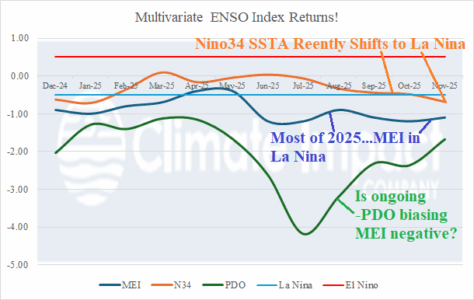
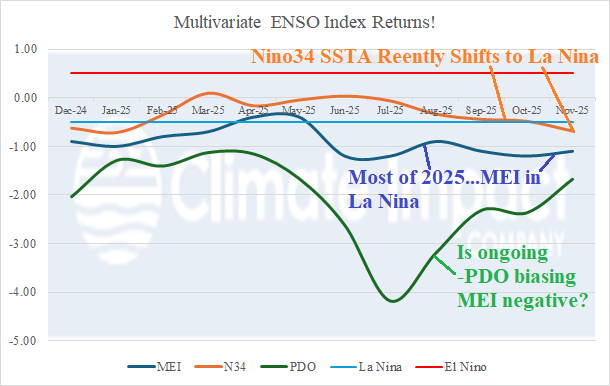
Multi-variate ENSO Index Returns! Identifies Well Established La Nina Climate!

An important climate diagnostic, missing since last April, has returned this month: Multivariate ENSO index (MEI). The MEI identifies the response of the atmosphere (30S to 30N) to the Pacific equatorial sea surface temperature anomaly (SSTA) regime. Note that the conventional climate diagnostic to identify ENSO phase, the Nino34 SSTA, only recently shifted to La Nina. A La Nina regime is indicated by MEI all but APR and MAY of the past 12 months.
12/16/2025, 4:43 am EST

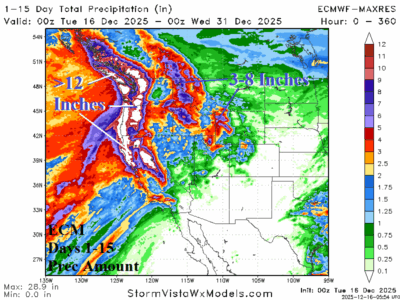
Historical Precipitation Event Ahead West U.S. – Causes and Implications

The 2025-26 cold season is barely underway and already two dramatic weather regimes are identified: 1.) The just-ending arctic outbreak across the East U.S. and 2.) The evolving excessive precipitation event for the West Coast lasting the remainder of December and into January.
12/15/2025, 4:07 pm EST

At The Surface, La Nina Strengthened Last Week. However, Subsurface Cool Fuel Diminishing.

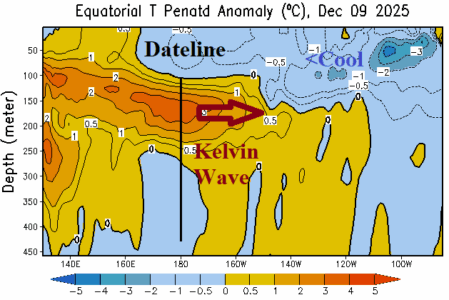
During the past week, the Nino34 and Nino3 sea surface temperature anomaly (SSTA) regions across the east-central and east equatorial Pacific Ocean cooled to the second strongest level of the weak late 2026 La Nina episode. The central equatorial Pacific and off the northwest coast of South America are near normal. Of interest is the appearance of a Kelvin Wave shifting east of the Dateline during early December.
12/14/2025, 10:06 am EST

MJO is Now Quiet, Stratosphere Colder, Therefore, a Milder U.S. Pattern Ahead. But! There are Caveats!

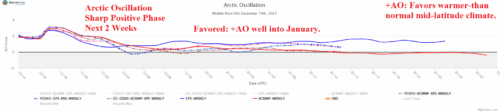
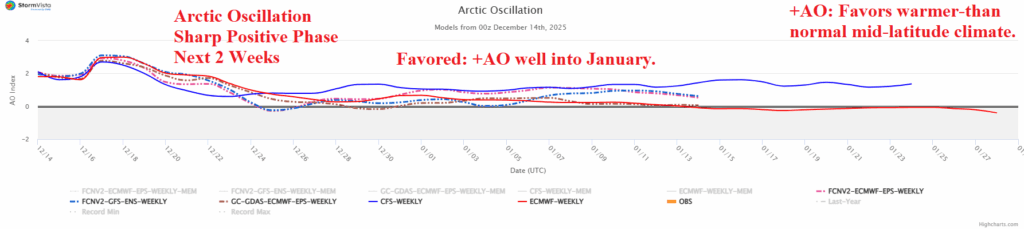
The arctic oscillation (AO) which identifies the location of the polar vortex indicates a change to positive phase the next 1-2 weeks as the recent frigid Canadian polar vortex shifts poleward. The shift toward the North Pole allows milder Pacific maritime influence to warm the U.S. pattern. The extended-range AO forecast suggests the positive phase may continue well into January. However, there are caveats.