02/15/2022, 12:51 pm EST

Great Plains Snow Cover Increase Ahead

A colder trend for the West-central/Central U.S. initiated last night for next week. The colder change is inspired by increasing snow cover in the Great Plains.
02/10/2022, 12:50 pm EST

U.S. Winter 2021-22 Is Warm So Far (But Character is Volatile)

Weather within climate is what's most important to the public and industry. Winter 2021-22 is warmer than normal so far for the U.S. But that assessment is the average of a near record warm December and a cold mid-winter pattern change.
02/09/2022, 2:46 pm EST

Frigid Northeast Early Next Week

Another arctic air mass sweeps into the Northeast U.S. trailing an Alberta Clipper early next week. ECM indicates the cold may be the strongest of the season for this region.
02/09/2022, 1:26 pm EST

Drought Risk Increasing for Central/South Great Plains and Texas Plus Florida

The Effective Drought Demand Index (EDDI) identifies an extremely thirsty atmosphere across the Great Plains to parts of the Midwest U.S. in early February. A drought condition could emerge quickly in these regions (unless already developed) if significant precipitation fails to occur.
02/08/2022, 8:15 am EST

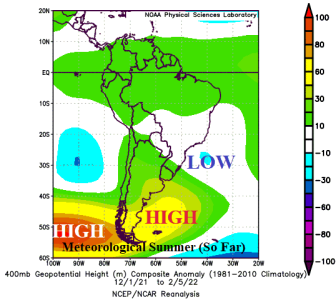
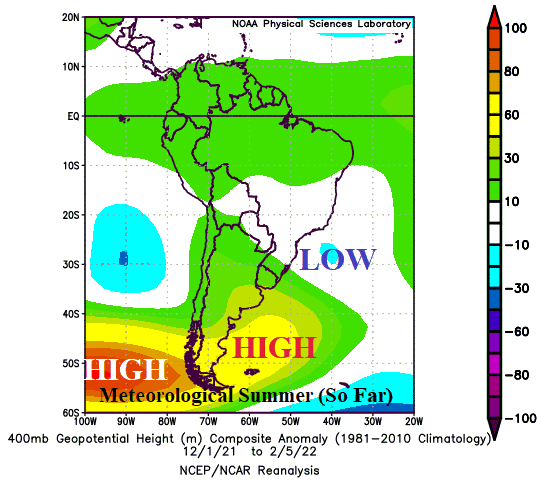
New Factors Causing Hostile Argentina/Brazil Climate Regime of Summer 2021-22 So Far

An unusually hostile climate pattern has emerged in South America during the 2021-22 warm season. Anomalous heat and dryness have propelled a drought in Paraguay to Southeast Brazil to Northern Argentina while excessive rains have plagued Brazil. While La Nina has contributed to this pattern, the more likely specific catalyst is the semi-permanent upper-level low-pressure trough southeast of Brazil extending northwestward into Brazil to cause convective rains compensated for by subsidence on the back side of that rainfall and centered on Paraguay and Argentina to cause just-the-opposite climate pattern – dryness and heat to accelerate drought.
02/07/2022, 4:48 am EST

Madden Julian Oscillation Rainfall Influence On Southeast Asia, Australia and South America in February

The convective phase of the Madden Julian oscillation (MJO) is forecast to strengthen in the same position over the next 2 weeks possibly lingering into March. To compensate for this vast region of convection, the downstream effect is an area of subsidence extending across South America. The influence on climate is profound. The immediate important influences include an expansive very heavy rainfall pattern over Southeast Asia, the eastern Indian Ocean and Indonesia while the influence on South America is to make the climate drier.
02/03/2022, 11:29 am EST

Climate Signals Indicate a Westward Shift in the Cold Pattern for Mid-February in U.S.

The morning medium-range forecast indicates a westward shift in the East U.S. mid-winter cold pattern. Support for the westward shift of the cold is most apparent in the 8-14/11-15-day period when the Pacific North America index flips to negative phase and the North Atlantic oscillation becomes positive. The implied eastern warm-up is suppressed by snow cover.
02/02/2022, 8:02 am EST

Another Major U.S. Storm! Major Icing Event East-central States!

Another major storm has emerged across the Central and into the East U.S. for mid-to-late week featuring a swath of heavy snow, ice, heavy rains and following bitter cold. Of special importance is the risk of heavy icing tomorrow from near Memphis, TN to the southeast Ohio Valley.
02/02/2022, 7:59 am EST

2011/2021 Ocean Comparison and Following January U.S. Soil Moisture

The 2011 and 2021 ENSO/PDO/AMO regimes are strikingly similar. In January of the following year, this regime produced nationally dry soils in January 2012 which was followed by a bad drought during the following summer. Climate Impact Company is closely following a similar climate pattern into early 2022 which could lead to important drought for summertime ahead!
02/01/2022, 8:41 am EST

Cold U.S. Pattern Abates Later February

The deep cold of mid-winter becomes choppy the first half of February maintaining above normal national heating demand for the U.S. However, later February the U.S. pattern shifts warmer.