
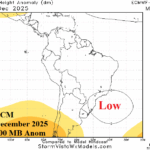
Influence on South America Climate of the Coastal Brazil Upper-level Low-pressure Area
10/06/2025, 7:11 am EDT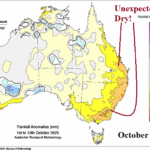
The Surprising Dry Climate in Australia
10/13/2025, 6:05 am EDT
October 2025 Climate Impact Company ENSO Outlook
Issued: Wednesday October 8, 2025
Highlight: Weak La Nina arrives shortly. ENSO phase change to El Nino possible by middle of next year.
Executive summary: A weak La Nina is forecast for Q4/2025 shifting to neutral phase during early 2026 and possibly to El Nino during the middle of next year. A strong ENSO episode within the next 12 months is not expected although forecast confidence in a phase change is reasonable. ENSO phase continues to influence global climate. However, the sharp warming of the mid-latitude oceans of the past decade will continue to equal ENSO on climate influence during the second half of this decade. Additionally, the cool phase of the long-term ENSO cycle, which began during the mid-to-late 1990’s and typically lasts 2-4 decades, may be nearing an end. If so, El Nino frequency may increase beginning late this decade.
Discussion: The SEP-25 Nino34 SSTA index was -0.44C, slightly warmer than the -0.50C La Nina threshold. The daily Nino34 SSTA index valid for October 7th was -0.53C. Slowly, the Nino34 SSTA is cooling. The Long Paddock southern oscillation index (SOI) was neutral in August and September. The daily SOI is +0.43, weakening after a daily peak of +1.56 last week. The SOI may shift briefly negative due to an eastward pulse of Madden Julian oscillation (MJO) convection across the tropical Pacific reconvening in the western Indian Ocean after mid-October when SOI should flip positive again. A steady +SOI, a sign of a La Nina climate, is not apparent (yet). The East Pacific equatorial upper ocean heat is marginally cool and about half as cool as JAN-25 when the operational Nino index was barely within La Nina range at -0.6C. The lack of steady +SOI and marginally cool subsurface temperatures suggest the anticipated La Nina for late 2025 is weak. Various Nino34 SSTA forecasts are agreeable to the Q4/2025 La Nina development. However, NCEP CFS V2, ECMWF, and POAMA (Fig. 1-3) may be too strong with La Nina at initialization (and therefore the Q4/2025 forecast). The CIC constructed analog (Fig. 4) is weaker with the Q4/2025 La Nina. The CIC outlook indicates El Nino risk for 2026. The CFS V2 warms the Nino34 SSTA to the El Nino threshold by MAY/JUN-26 while extrapolation of the ECMWF Nino34 SSTA forecast suggests a similar result.

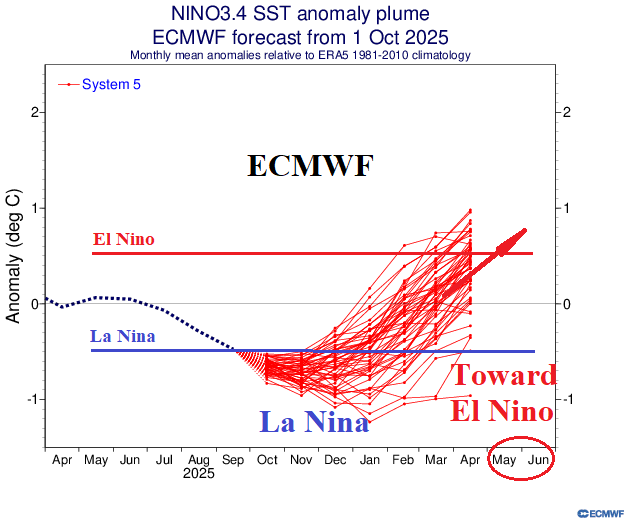

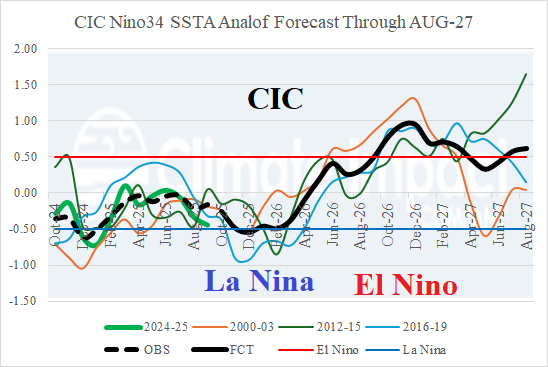
Fig. 1-4: The Nino34 SSTA forecasts from NCEP, ECMWF, POAMA, and CIC.